

An improved cookstove distributed to a household in Madagascar is not impact. It is an intervention. Impact is what happens if that stove is still in daily use three years later, if the family have stopped burning wood on the open fire alongside it, if the mother’s hours spent collecting firewood have measurably shrunk, if the daughter is in school instead of out gathering fuel, if the household’s smoke exposure is down. Impact is a lasting change in the way people live. The stove is a means. The change is the point.
That distinction matters because it changes how a programme has to be designed, monitored and financed. A programme measured on interventions delivered can stop the day the stove leaves the truck. A programme measured on outcomes has to keep going for as long as the outcome depends on the intervention — which for a household stove is well beyond the moment of distribution.
This article sets out how SaniTap thinks about impact as outcome rather than intervention, the theory of change that connects the two, and why ongoing behavioural monitoring — not just event-time counting — is the discipline that separates real impact from delivery statistics.
In one minute
- Impact is the outcome, not the intervention. A stove distributed is not impact; a household that cooks cleaner three years later is.
- Theory of change is the honest chain that connects an intervention to a sustained outcome: activity → immediate effect → behavioural change → sustained effect → lasting outcome. Every link is a place where the chain can break.
- Two SaniTap programmes, two theories of change: clean cooking (adoption + sustained use + stove-stacking discipline → lasting fuel and smoke reduction) and safe water (functional infrastructure + correct use + hygiene behaviour → lasting waterborne-disease reduction).
- Behaviour breaks the chain more often than infrastructure does. Stoves get left on shelves. Pumps get used only during the dry season. Households revert to old habits when nobody is watching.
- Ongoing monitoring — through sensors on stoves, through the mWater dashboard on water points, through recurrent household surveys, through community-engagement teams that stay in place — is what catches drift before it becomes reversion.
- Reinforcement mechanisms matter as much as the original intervention. Hygiene and gender promotion, refresher training, warranty and maintenance networks, community champions, all keep the behavioural change alive.
Impact is the outcome, not the intervention
The habit in the development sector — inherited from decades of donor reporting that priced projects on activity metrics — is to describe impact using the language of delivery. “We distributed X stoves. We rehabilitated Y water points. We reached Z beneficiaries.” These are useful facts. They are not, by themselves, impact.
The reason they are not impact is that any one of them could have gone wrong quietly, in the weeks or months after the number was recorded. A stove distributed to a household that never lights it. A pump rehabilitated in a community that reverts to the same contaminated river when a spare part fails and nobody comes. A beneficiary counted at a distribution event who has moved to a different village by the following season. Delivery statistics are records of what was done. They are silent on what happened afterwards.
Impact is what happened afterwards. It is measured in the sustained state of the household or the community after the intervention had time to take. And it is the thing SaniTap’s projects are ultimately accountable for.
Theory of change — the chain from activity to outcome
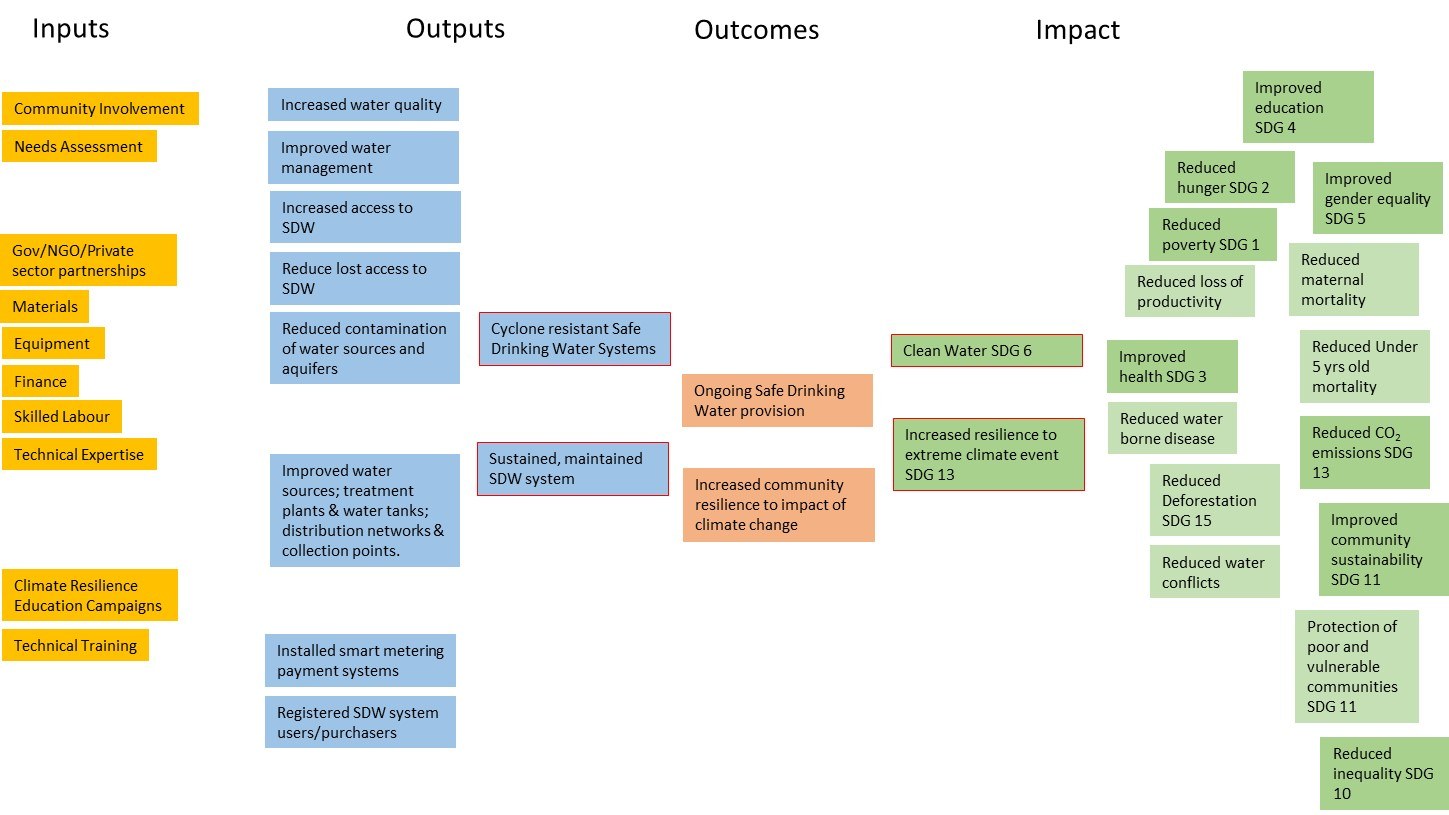
Theory of change is a plain-English tool for writing down, honestly, the chain of causation that connects an intervention to the outcome it is meant to produce. A useful theory of change has five links:
- Activity — what the programme actually does (distribute stoves, rehabilitate a water point, train an operator).
- Immediate effect — what changes in the moment of the intervention (a stove is in the house; the pump produces water).
- Behavioural change — how the household or community starts using the intervention (they cook on it daily; they draw water from it as their primary source).
- Sustained effect — how the behavioural change persists over months and years (they still cook on it after eighteen months; the pump is still their primary source after a cyclone season).
- Lasting outcome — the state of the household or community that the intervention was meant to produce (lower fuel use, cleaner indoor air, fewer waterborne-disease episodes, hours of women’s time reclaimed).
Every one of those links is a place the chain can break. A stove is delivered but never installed (breaks between links 1 and 2). It is installed but sits alongside the traditional fire — stove stacking — because family members are unfamiliar with it (breaks between 2 and 3). It is used daily for six months and then reverts to the traditional fire when the household size changes or the pellet-fuel supply is interrupted (breaks between 3 and 4). It is used consistently for two years but by then the impact is nullified by rising household size or by the deforestation of the surrounding fuelwood source (breaks between 4 and 5).
A programme that only counts stoves at distribution is measuring link 1. A programme that measures at link 5 is measuring impact. Everything in between is where the real work happens.
Two programmes, two theories of change
SaniTap runs two intervention programmes in Madagascar, and each has its own theory of change. Both are more than delivery-plus-hope.
Clean cooking
The theory of change for the clean cooking programme runs like this:
Activity. Distribute a high-efficiency biomass cookstove to a household, alongside brief training on operation and safety.
Immediate effect. The stove is installed and the household knows how to light it.
Behavioural change. The household adopts the stove as its primary cooking device, displacing the traditional three-stone fire or low-efficiency charcoal stove. This is where the biggest failure mode of clean cooking programmes lives, historically: stove stacking, where the improved stove is used alongside the old one rather than instead of it. Reducing stacking is a specific behavioural change that has to be induced and sustained, not assumed.
Sustained effect. The behavioural change holds over years, not months. The stove continues to be the primary device even when the family size changes, when the fuel supply shifts, when maintenance issues arise. Refresher engagement, warranty and repair infrastructure, and community-champion support all serve this link.
Lasting outcome. Meaningful, cumulative reduction in the household’s fuelwood burn, its smoke exposure, and the time women and girls spend collecting fuel. Aggregated across enough households, this becomes the credited climate mitigation outcome under the Gold Standard TPDDTEC methodology, but the primary story is the household’s changed daily life.
Safe water
The theory of change for the safe water programme runs differently:
Activity. Rehabilitate or install a community water source (a hand pump, a piped system, a solar-powered borehole with treatment and storage).
Immediate effect. Safe water is available at a functional source close to the community.
Behavioural change. The community adopts the source as its primary drinking-water supply, displacing river or shallow-well water. Alongside this, households adopt hygiene behaviours — safe water storage, hand-washing at critical moments, safe disposal — that turn a clean source into clean water at the point of consumption.
Sustained effect. The source remains functional and remains in primary use. This is where safe water programmes historically fail: infrastructure that breaks and is not repaired; sources that are abandoned in the wet season because the river is closer; hygiene behaviours that lapse when public-health promotion stops. The technical fix is professional maintenance; the behavioural fix is continued community engagement.
Lasting outcome. Sustained reduction in waterborne-disease burden, hours saved on water collection, and downstream effects on school attendance, child mortality, and household economic capacity.
Both chains are only as strong as their weakest link. Both require the programme to keep working after the intervention is complete. Neither is finished on the day the stove is distributed or the pump is unveiled.
Behaviour breaks the chain more often than infrastructure does
Any programme practitioner will tell you the same thing after enough field cycles: the failure mode that dominates programme outcomes is not usually the infrastructure. It is the behaviour that surrounds the infrastructure.
Stoves get left on shelves because the household has not built the habit of using them, or because the fuel supply is inconvenient, or because a family member preferred the old way and prevailed. Pumps get used only during the dry season because the river is closer and the community’s hygiene understanding is patchy. Households wash hands enthusiastically when the promotion team is in the village and revert when the team leaves. New water storage practices are adopted then quietly abandoned when the storage vessel breaks and is not replaced.
None of this is anyone’s fault. Behaviour change is genuinely hard. It is competing with decades of established household practice, with kin networks and cultural preferences, with the sheer inconvenience of doing something new when the old way still works, tolerably, most of the time.
The consequence for programme design is that the intervention itself is a much smaller part of the total effort than the reinforcement that has to accompany and follow it. A stove distribution that ends when the last stove leaves the truck is not a clean cooking programme. It is a stove distribution. The clean cooking programme is what happens over the following three to five years.
Ongoing monitoring — the discipline that catches drift
The way SaniTap knows whether the behavioural change is holding is by measuring it, repeatedly, after the event. This is where behavioural monitoring stops being a slogan and starts being a discipline.
Three concrete monitoring streams:
Sensor monitoring on a randomised sample of stoves. Beyond the household surveys required by the Gold Standard methodology, a randomised subset of distributed stoves carries usage sensors that record when the stove is lit and for how long. This produces objective, direct evidence of daily-use adoption that no household self-report can match. If sensor data on a cohort shows daily use dropping from 90% to 50% over eighteen months, that is a flag long before the next household survey would catch it.
mWater on every rehabilitated water point. Every hand pump under the MadAvance maintenance programme is registered on mWater, the WASH-sector data standard, with periodic functionality and water-quality checks. Every Endur’O piped system reports usage in real time through the NFC Smart Tap network. A tap that goes silent for a day is flagged before the community reports the fault. A pump whose usage falls off is a warning that either the technical condition has degraded or the community’s use pattern has changed.
Recurrent household surveys. Kitchen Performance Tests on the cooking side, household water surveys on the water side, gender and time-use surveys on both. These are done at intervals through the crediting period, not only at baseline and monitoring-report time.
The whole point of these streams is that they run through the years the intervention is supposed to be delivering its outcome, not just at the moments a monitoring report is due. Drift is caught early, and the response — a repair visit, a refresher training, a change of promotion emphasis — happens before drift becomes reversion.
Reinforcing the behavioural change
Monitoring tells the programme whether the behaviour is holding. Reinforcement is what keeps it holding. SaniTap uses several reinforcement mechanisms, mostly in partnership with MadAvance who carry the community relationships:
Continued hygiene and gender promotion. Monthly community engagement in the areas where hand pumps have been rehabilitated. The message is not just “use the pump” but “use the pump, store water safely, wash hands at the critical moments.” The behavioural bundle is what matters, not the pump alone.
Repair and maintenance made real. Every MadAvance repair team runs regular preventive maintenance on the pumps in its area, not just reactive repair when a community reports a failure. Every Endur’O piped system has a professional operator behind it with parts and skills already stocked. The message a community receives — infrastructure they can rely on, indefinitely — is the strongest possible reinforcement of the behavioural change to use it.
Warranty and refresher training for stoves. Distributed stoves come with warranty periods, replacement parts availability, and refresher training on operation and safety. A household whose stove develops a fault knows what to do, and the fix does not require them to revert to the traditional fire.
Community champions and local employment. The MadAvance repair technicians, the Endur’O shopkeeper agents, the field engagement staff — many of them are members of the communities served, and their continued presence in the programme is itself a signal that the intervention is not a one-off. Local employment is a reinforcement mechanism, not just an economic co-benefit.
Payment behaviour that carries meaning. Endur’O’s per-litre metering at the tap is a small daily act that reinforces the behaviour of using the piped system: the household chooses the tap, pays for the water, receives the water. That transactional loop, repeated daily, is what a flat monthly contribution to a village committee never was.
None of these is glamorous. All of them are boring, sustained, and unavoidable if the intervention is to translate into outcome.
What impact actually looks like on the ground
Where the theory of change and the monitoring and the reinforcement all hold, the picture on the ground looks different from the delivery-statistics picture:
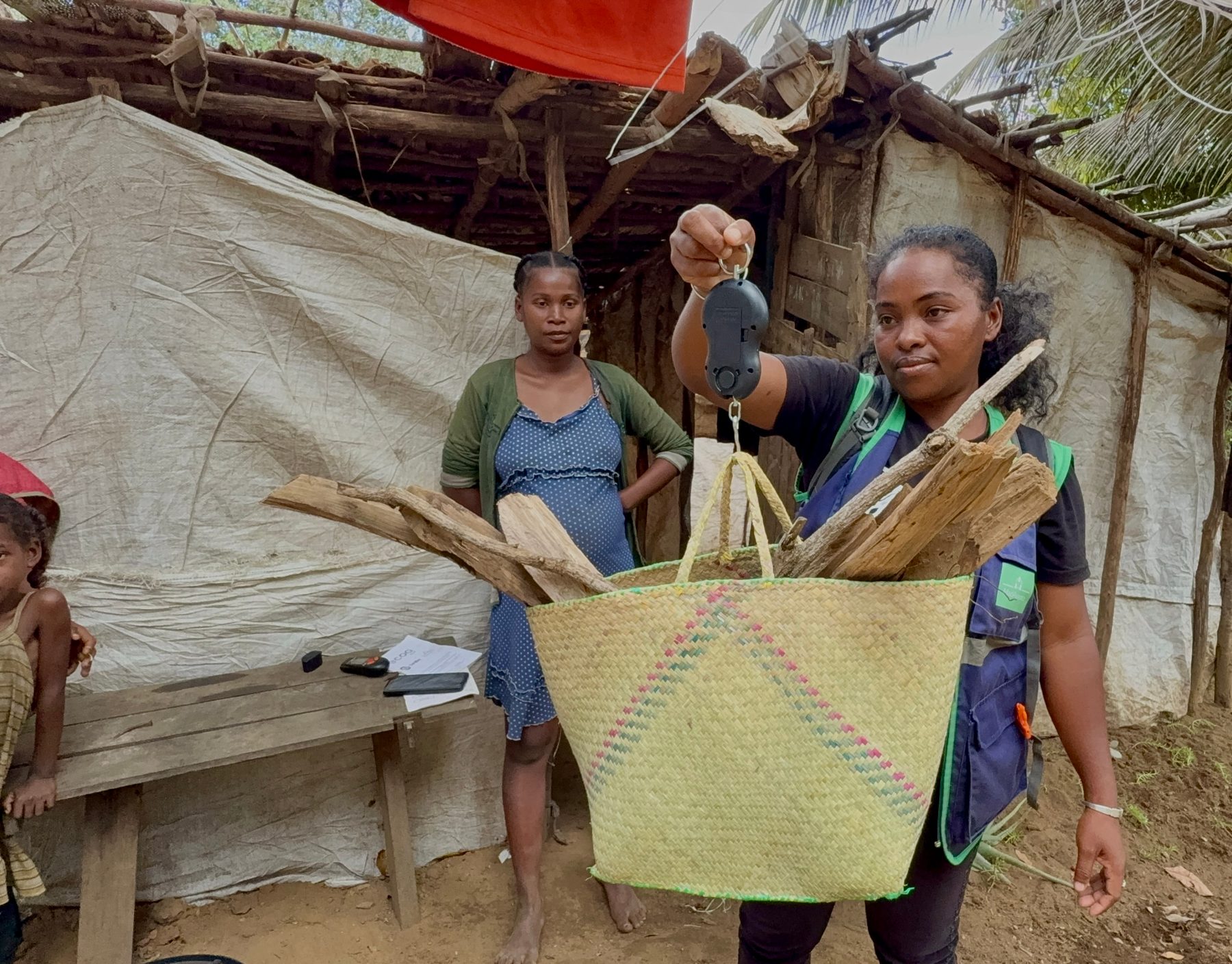
- A Malagasy mother who no longer walks two hours each way to collect firewood. Her stove burns 40-50% less biomass; her cooking is faster; her time is her own again. Her daughters are in school more often. This is what the 5,552 MGA per household per week fuel-cost savings figure from Monitoring Report MP1 looks like in a specific household. It is a change in daily life, not a line in a report.
- A village that has drawn safe water from the same restored hand pump for four cyclone seasons. The pump has needed two preventive-maintenance visits and one repair. The community has never reverted to the river as its primary source. Waterborne-disease episodes are down measurably. This is what “97% functionality” and “50% reduction in waterborne disease” look like when you disaggregate them to the community level.
- A network of shopkeepers earning commission from Endur’O NFC Smart Tap top-ups. The shopkeepers are part of the water system’s economics. Their livelihoods depend on the piped water continuing to work and continuing to be used. Their interest in the system’s success is an ongoing structural reinforcement of the behavioural change to buy piped water rather than fetch it from the river.
- A hundred and twenty thousand kitchens where the smoke has thinned. Not just because a stove was delivered, but because families adopted it, kept using it, replaced faulty parts, ignored the temptation to stove-stack, and let a generation of children grow up in cleaner indoor air.
None of these outcomes exist because a stove or a pump was delivered. They exist because a stove or a pump was delivered and then everything that had to happen afterwards actually happened. Impact is the sum of the delivery and the afterwards.
Why we treat monitoring as investment, not overhead
The traditional development-sector accounting sees monitoring as an overhead cost: money spent on measurement that could otherwise have gone into more interventions. Under that logic, monitoring is minimised.
SaniTap’s view is the opposite. Monitoring is the mechanism by which delivery becomes outcome. Cutting monitoring cuts the outcome. A programme that distributes twice as many stoves but monitors half as intensively will produce fewer household-years of sustained clean cooking than one that distributes fewer stoves and monitors thoroughly. The delivery number will look bigger; the outcome will be smaller.
That is why the safe-water programme runs Cabinet MANO 2025 evaluations at the community level, keeps the mWater dashboard live, and staffs continuing preventive-maintenance rounds through MadAvance. It is why the clean-cooking programme runs sensor monitoring on a randomised subset of stoves, alongside the household surveys required by the Gold Standard methodology. And it is why the community engagement teams stay in place after the initial distribution rather than moving on to the next donor cycle.
The alternative — count what was delivered, publish a big number, and hope the outcome follows — is the pattern that has produced two decades of well-meaning programmes with disappointing sustained results in the development sector. Impact as outcome, held by theory of change, sustained by monitoring, reinforced by community engagement, is a slower and more honest way of working. It is also the only way of working that actually produces impact.
Related
- Live impact tracker — the current cumulative outcome numbers, ticking up in real time.
- Impact Measures Dashboard — the full set of impact measures across the programmes, filterable by SDG.
- SaniTap–MadAvance model — company speed, NGO trust — the partnership that carries the community relationships behind the reinforcement work.
- Piped water at scale — how Endur’O turns a fragile utility into a durable one — how the NFC Smart Tap turns a daily transaction into a behavioural reinforcement.