

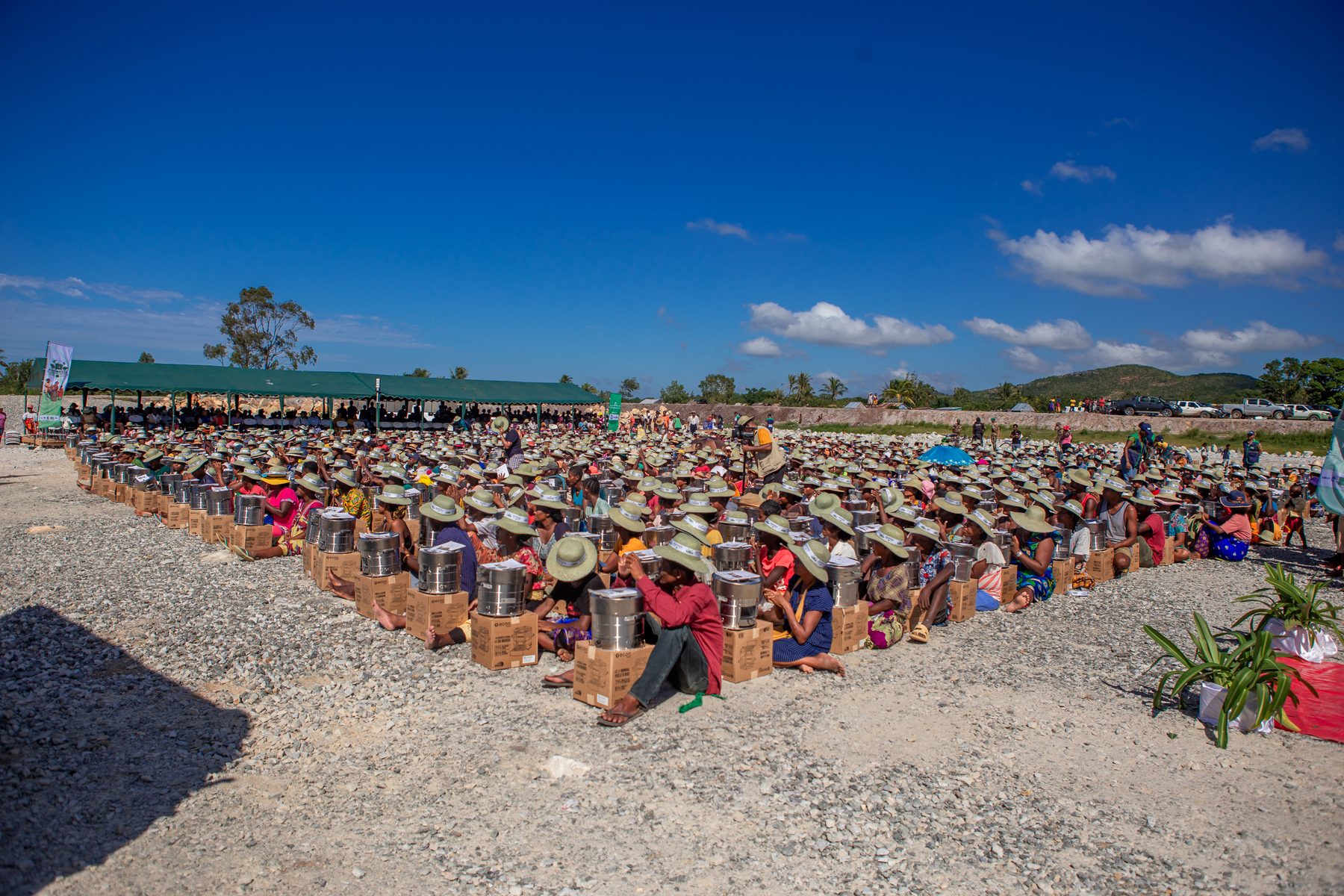
Most carbon-mitigation portfolios spread themselves thin across many countries and many technologies. SaniTap has taken the other route: two intervention types, deep, in one country. Clean cooking and safe drinking water in Madagascar.
That is not an accident of history. It is a deliberate design choice, and it produces two things that thin, spread-out portfolios cannot: operational leverage (one country team, one MRV infrastructure, one government relationship) and methodological compounding (both interventions credit the same underlying scientific parameter — the fraction of non-renewable biomass burnt in Madagascar). This article explains how the two levers work, how they interact, and what that means for the credits SaniTap generates.
In one minute
- Clean cookstoves reduce biomass combustion at the point of use (households cooking with high-efficiency stoves instead of open fires).
- Safe drinking water reduces biomass combustion at the point of avoidance (families no longer boil contaminated water on wood or charcoal fires).
- Both are credited under Gold Standard methodologies (TPDDTEC v4.0 for cooking, ERSDWS v1.0 for water).
- Both scale with the same fraction-of-non-renewable-biomass (fNRB) parameter for Madagascar — currently 54% monitored, from Cabinet MANO 2025.
- Together they cover the two biggest categories of avoidable emissions in a rural Malagasy household.
The problem: biomass at both ends
In a rural Malagasy household with no piped safe water and no electricity, wood or charcoal is used to do two things:
- Cook the day’s food — one to three fires a day, typically on an open three-stone stove or a low-efficiency traditional metal charcoal stove.
- Boil contaminated drinking water — where the household has no alternative to river or shallow-well water, boiling is the only affordable way to make it safe.
Both are combustion. Both emit CO₂. Both draw wood or charcoal from natural forests. Both fill the household air with particulates that shorten women’s and children’s lives.
A mitigation portfolio that only addresses one of them leaves the other running. If you distribute clean cookstoves but leave the boiling problem in place, families keep lighting biomass fires to make water safe. If you restore safe water but leave families cooking on open fires, the biggest daily combustion source stays intact.
SaniTap runs both.
The clean cooking lever
The clean cooking programme distributes high-efficiency biomass cookstoves — pellet-metered stoves and improved charcoal stoves — that cut the amount of fuel needed to cook a given meal by roughly half compared to a traditional three-stone fire.
The credit is issued under the Gold Standard TPDDTEC methodology (Technologies and Practices to Displace Decentralised Thermal Energy Consumption, v4.0). The formal accounting logic is:
Emission reduction = (baseline biomass burn − project biomass burn) × emission factor × fNRB
Every term matters. Baseline burn is measured through Kitchen Performance Tests. Project burn is measured through the same test on the improved stove. The emission factor converts tonnes of wood to tonnes of CO₂. The fNRB — the fraction of non-renewable biomass — is what protects the credit against being over-issued in a place where biomass would have regrown anyway.
For Madagascar’s east coast, fNRB is currently monitored at 54% (Cabinet MANO 2025, updated from an earlier PDD figure of 67.7%). That means only 54% of the wood a household would otherwise have burnt would have caused a net atmospheric CO₂ increase; the other 46% would have regrown within the accounting period. Only the 54% is credited.
This is a deliberately conservative parameter. It is also the parameter that ties clean cooking to safe water.
The safe water lever
The safe water programme restores rural community water points (hand pumps, rehabilitated wells, boreholes with locally-produced Canzee pumps) and operates piped water systems through Endur’O. Restoring a water point means a household no longer has to boil contaminated water to make it safe.
The credit is issued under Gold Standard ERSDWS v1.0 (Emission Reductions from Safe Drinking Water Supply). The accounting logic mirrors cooking:
Emission reduction = (baseline boil-water biomass burn − project boil-water biomass burn) × emission factor × fNRB
Baseline biomass burn is the wood a household would have used to boil drinking water in the absence of the intervention. Baseline boiling rates are measured through direct household surveys in the project area. Post-intervention boiling rates drop to close to zero when a nearby water point is functional.
The same fNRB applies — 54% for Madagascar’s east coast, from the same Cabinet MANO monitored evidence.
This is not a coincidence. Both methodologies credit avoided biomass combustion in the same country against the same set of national deforestation dynamics. Which is why running both from one country is more than the sum of its parts.
Why doing both, in one country, compounds
Three ways.
Operational leverage
One MadAvance field team monitors both hand pumps (for water) and cookstove adoption. One government relationship supports both project types under one Letter of Approbation. One community-consultation process runs alongside both interventions. One local hire — a MadAvance repair technician — services water points and engages households on stove adoption.
The cost of running mitigation credit projects is dominated by field infrastructure: monitoring, verification, community engagement, maintenance. Spread that infrastructure across two credit types in one country and the cost per tonne of credit falls sharply.
Methodological compounding
The single most contested parameter in cookstove and safe-water crediting is fNRB. It is expensive to establish, and it is the number auditors scrutinise hardest. SaniTap invests in a single, rigorous, Cabinet-MANO-monitored fNRB for Madagascar’s east coast, and that same parameter supports both project types.
The alternative — separate fNRB studies for cooking in one country and safe water in another — is what happens when a portfolio is spread thin. It costs more, it produces less confidence, and it usually converges on more conservative parameters.
Household compounding
The same household benefits from both interventions. A family that gets an improved stove and access to a restored community water point no longer needs to burn wood either to cook or to boil water. Both fires are gone. The health benefit — hours of women’s and girls’ time back, DALYs averted from reduced indoor air pollution — is not additive between the two interventions, it is closer to multiplicative. A household with clean cooking and safe water is a categorically different household than one with only one of them.
What this adds up to on the credit side
At today’s programme scale, SaniTap’s combined mitigation portfolio is delivering roughly the annualised figures shown on the live impact tracker and the Impact Measures Dashboard. The tonnes-of-CO₂e-avoided figure that appears on the home page — currently the year’s forecast — is the sum of cooking and safe water, both under Gold Standard methodologies.
For buyers, the combined portfolio offers two things a single-intervention portfolio does not:
- Diversified integrity risk within one country. If the fNRB parameter for Madagascar were revised down in a future monitoring cycle, both credit types would shift together, but SaniTap would still have two independently-verified project types. Buyers with strict single-methodology-concentration limits can spread their SaniTap allocation across two Gold Standard programme areas.
- Cleaner co-benefits story. SDG 6 (Clean Water and Sanitation) sits alongside SDG 7 (Affordable and Clean Energy), SDG 13 (Climate Action), and SDG 15 (Life on Land) in the same portfolio. For corporate buyers evaluating credits against internal ESG frameworks, the co-benefit surface is wider without being weaker.
SaniTap’s single-country depth is a strategic choice: more than a decade of Malagasy government relationships, a partnership model with a local NGO (MadAvance) and a domestic utility joint venture (Endur’O), and the operational infrastructure that lighter-touch entrants cannot replicate quickly. Buyers who value that depth find SaniTap’s structure sits well with their procurement.
Related
- How safe water displaces carbon — the boil-water story — the safe-water credit logic in detail, including baseline surveys and sensor monitoring.
- TPDDTEC v4.0 — how clean cookstove credits are calculated — the cooking-side methodology and stove-adoption monitoring.
- ICVCM Core Carbon Principles in plain language — the integrity framework both methodologies are aligned with.
- SaniTap’s Adaptation Benefits Mechanism work — how the same country presence supports non-market adaptation finance alongside mitigation credits.