

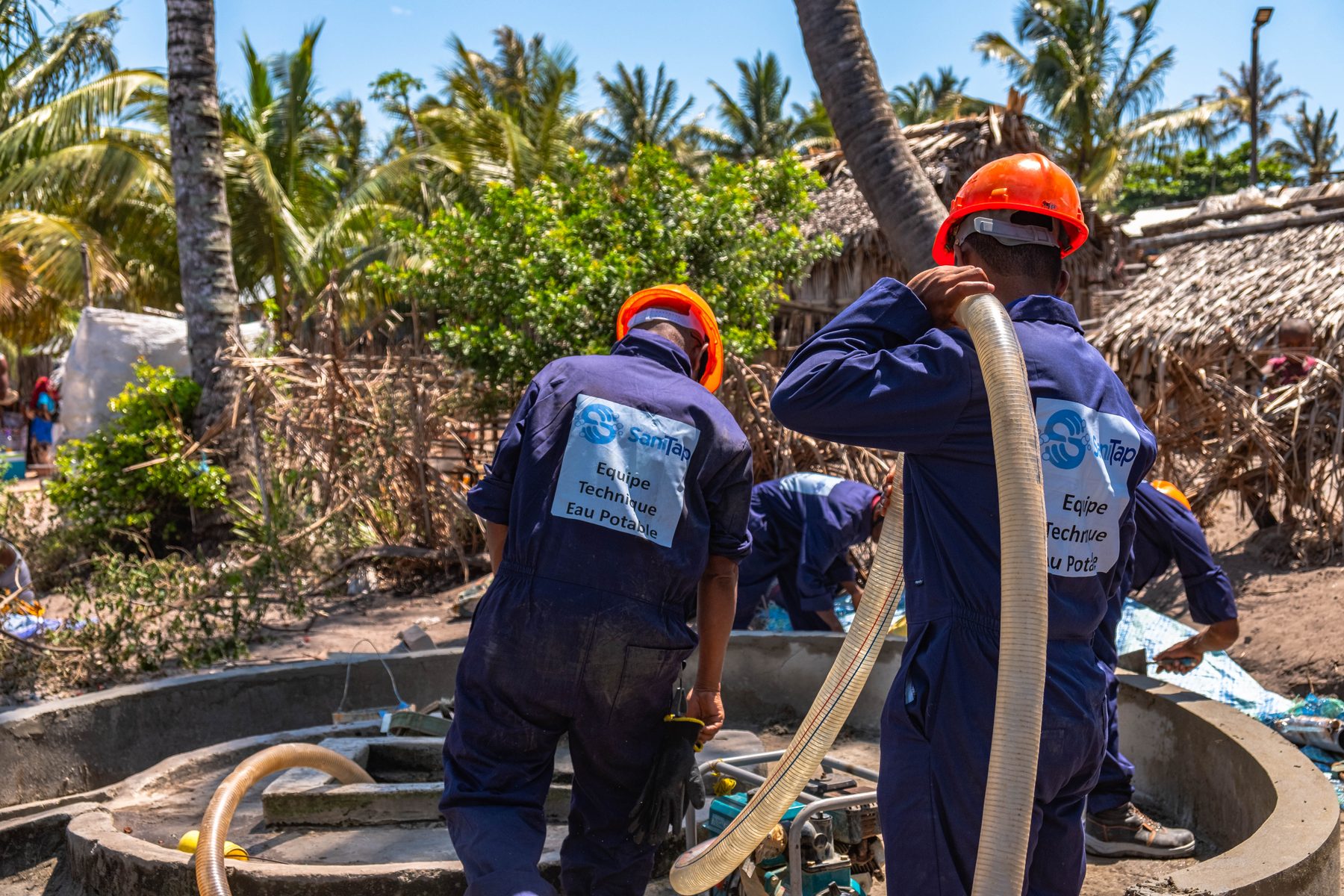
The Paris Agreement’s Article 6 has three parts. Two of them are about trading tonnes of CO₂ between countries. The third, Article 6.8, is about something else entirely: cooperative climate action that is not, and cannot be, structured as a tradable unit.
Article 6.8 exists because the negotiators who drafted the Paris Agreement recognised that some of the highest-value climate work resists the market model. Adaptation is the clearest case. Building a water system that survives a cyclone; hardening a coastal community against sea-level rise; restoring safe drinking water access after a storm surge fouls a source; these do not produce tonnes of avoided CO₂ as their primary output. They produce functioning infrastructure, in the future, when the storm arrives. That output has profound value. It cannot be sold in a carbon market.
For a long time this made adaptation harder to fund than mitigation. The Adaptation Benefits Mechanism, developed by the African Development Bank, is one of the operational vehicles being built under Article 6.8 to close that gap. SaniTap’s approved methodology under the ABM, Access to Tropical Storm-Resistant Safe Drinking Water Systems, is one of the concrete instruments. This article explains all three: the framework, the mechanism, and the methodology.
Executive summary
- Article 6.2 is bilateral trading of mitigation outcomes between countries (ITMOs).
- Article 6.4 is the successor to the Clean Development Mechanism — a UN-supervised market for mitigation credits.
- Article 6.8 is non-market cooperation: internationally recognised climate action without tradable credits.
- The Adaptation Benefits Mechanism (ABM) operationalises Article 6.8 for adaptation. It certifies discrete units — adaptation benefits — that funders can purchase directly without any trading.
- SaniTap’s methodology Access to Tropical Storm-Resistant Safe Drinking Water Systems (v2.0, approved November 2024) generates two adaptation-benefit units: new safe-water access, and maintained safe-water access through storm events.
- The mitigation co-benefit (CO₂ saved because families no longer boil contaminated water on wood fires) stays inside Madagascar’s Nationally Determined Contribution and is not traded — the whole point of the non-market route.
Contents
The three mechanisms in Article 6
Article 6 of the Paris Agreement sits under a heading of voluntary cooperation between countries to achieve their Nationally Determined Contributions. It has three operational sub-articles.[1]
Article 6.2 — Cooperative Approaches. Bilateral or multilateral cooperation on Internationally Transferred Mitigation Outcomes (ITMOs). One country’s over-achievement on its NDC becomes tradable to another country that needs to purchase mitigation outcomes toward its own NDC. Traded units are subject to corresponding adjustments, so a tonne counted by the buyer is not also counted by the seller.
Article 6.4 — The Article 6.4 Mechanism. Successor to the Kyoto Protocol’s Clean Development Mechanism. A UN-supervised international carbon market where individual projects generate credits, called Article 6.4 Emission Reductions (A6.4ERs), that any country or eligible entity can purchase. The Supervisory Body sits under the UNFCCC and approves methodologies, projects and monitoring.
Article 6.8 — Non-Market Approaches. Cooperative climate action that is not structured as trade. The Article 6.8 framework describes it as facilitating “the implementation of ambitious mitigation and adaptation actions”, with a specific role for finance, capacity-building and technology transfer that does not fit the credit model.
The distinction is not procedural. The three mechanisms produce fundamentally different things. Articles 6.2 and 6.4 produce fungible units that can be transferred, retired, or held against a compliance target. Article 6.8 produces cooperative outcomes — projects funded, capacity built, technology deployed, adaptation delivered — with no tradable instrument attached. The recipient country accounts for the outcome in its own NDC. The funding country recognises the contribution in its own climate finance reporting. No unit crosses between them.
This is a feature, not a limitation. Some of the highest-value climate work is genuinely public-good in nature. Trying to shoehorn it into a market creates distortions and, in some cases, blocks the work from happening at all.
Why adaptation is a non-market activity
Three structural reasons.
No fungible unit exists. A tonne of CO₂ avoided in Peru is meaningfully equivalent to a tonne of CO₂ avoided in Madagascar; both remove the same amount of greenhouse-warming potential from the atmosphere. There is no equivalent physical common denominator for adaptation. A restored water point in Anosy is not equivalent to a mangrove replanting in Toliara, which is not equivalent to a cyclone shelter in Sambava. Each produces a different physical output for a different population against a different climate hazard. There is nothing to trade.
Adaptation benefits are local and diffuse. A cookstove installed in a Malagasy household reduces atmospheric CO₂ that would otherwise contribute to global warming that affects everyone. A hardened water system installed in that same household reduces the risk of that household losing safe drinking water in a specific storm event. The mitigation benefit is genuinely global. The adaptation benefit is genuinely local. A global carbon market can price a global benefit; it does not know how to price a local one.
Additionality is easier to defend for mitigation than for adaptation. Mitigation additionality asks: would this emission reduction have happened without the credit? Adaptation additionality asks: would this resilience have been built without the finance? The second question is harder because the counterfactual is usually a slower, worse, or non-existent adaptation, not a clean baseline. Markets that require sharp additionality tests tend to under-price this fuzzier counterfactual.
The combined effect: adaptation finance has trailed mitigation finance by roughly ten to one throughout the Paris era, despite adaptation being the more immediate need for most vulnerable countries.[2] The gap is not caused by lack of interest from funders. It is caused by the absence of an instrument that lets non-market adaptation cooperation be quantified, certified and paid for at scale.
That instrument is what Article 6.8 was meant to create.
Why we still do adaptation — the human case
The temptation, faced with a market-friendly instrument (carbon credits) and a market-unfriendly one (adaptation benefits), is to build the portfolio around the friendlier instrument and let adaptation wait for public finance to catch up. SaniTap does not accept that trade.
Three reasons.
The exposure is immediate. Madagascar sits in the world’s second-most-active tropical-cyclone corridor after the North-West Pacific. Roughly 1.7 landfalls per year, most between January and March. Cyclone intensity in the South-West Indian Ocean is rising; power-dissipation-index projections through 2100 point to a further substantial increase.[3] Families whose water infrastructure is fouled or destroyed in a storm today cannot wait for the next credit cycle. They need infrastructure that survives the storm, and they need it before the storm comes.
The population is stable and known. The east coast communities exposed to cyclones today are the same communities exposed to cyclones in the 1980s. Adaptation investment in a specific fokontany protects that fokontany indefinitely. There is no risk of the beneficiary population moving out from under the investment.
The interventions are engineering, not experiments. A sealed borehole is a sealed borehole. A solar-powered pump with battery backup, an elevated storage tank above maximum flood levels, on-site chlorination and a distribution network engineered for Category 4-5 winds — these are well-understood civil-engineering solutions. Deploying them requires funding, not further research.
SaniTap’s position, developed in partnership with MadAvance and evidenced through the coast-wide need ranking underlying the CRSDW methodology, is that these communities’ adaptation needs are quantifiable, addressable, and — under the Article 6.8 / ABM framework — fundable. The route to funding is the ABM.
The ABM as a non-market solution
The Adaptation Benefits Mechanism was developed by the African Development Bank as an operational vehicle for Article 6.8-style adaptation cooperation. The design predates the Paris Agreement’s Article 6.8 negotiations but the ABM has evolved to fit inside them.[4]
The core innovation is the adaptation benefit unit — a discrete, physically measurable output of an adaptation intervention that funders can pay for. The ABM’s guidelines set out four requirements:[5]
- Physically measurable. Not a proxy for the outcome; the actual output. If the intervention delivers safe drinking water access to X persons, the unit is X persons — not a modelled outcome or a health proxy.
- Attributable to the activity. The counterfactual (no ABM activity) must not produce the same benefit. This is the ABM equivalent of additionality.
- Additional. The activity would not have gone ahead without ABM support. This is documented in the Adaptation Design Document (ADD).
- Independently verified. An accredited validator confirms the units are real and correctly quantified, using the same institutional pattern as Gold Standard or Verra validation.
Governance sits with the ABM Executive Committee (ABM EC), hosted by the AfDB. Methodologies are proposed by developers, assessed against the ABM Methodology Guidelines,[6] and approved for use. Projects using an approved methodology are then registered, monitored, and their adaptation benefits certified by verification.
Buyers pay per adaptation benefit delivered — typically under a multi-year purchase agreement structured against the ABM ADD’s projected benefit schedule. Unlike carbon credits, ABM benefits are not held as tradable units; the buyer receives an attestation that a specified number of benefits have been generated with their funding, verified independently, and that no other party has claimed the same benefits.
Because ABM benefits are not tradable, they cannot substitute for corporate carbon offsetting. Instead they map naturally onto:
- Bilateral adaptation finance commitments made by developed-country donors under the Paris Agreement’s climate-finance obligations.
- Development-bank adaptation portfolios (AfDB, IDB, ADB, World Bank).
- The Loss and Damage Fund established at COP27 and formally launched at COP28.
- Corporate adaptation-finance funds that require clean accounting separation from mitigation offsets.
SaniTap’s approved methodology
SaniTap’s approved ABM methodology is titled Access to Tropical Storm-Resistant Safe Drinking Water Systems.[7] It was submitted by SaniTap Ltd, is currently at methodology version 2.0, and was approved by the ABM Executive on 29 November 2025.
The methodology covers climate change adaptation activities that restore and maintain indefinite access to safe drinking water for communities in regions where the increased frequency and intensity of tropical storms caused by climate change can stop, damage, contaminate, or restrict access to safe drinking water. The specific climate hazards addressed are flooding, destruction by wind, and storm surge in coastal areas. The climate parameters are precipitation and wind.
Eligible activities
Three activity types are eligible under the methodology:
- Building, restoring or upgrading safe drinking water sources that are resistant to tropical storms and their after-effects. Typical examples include new installations of solar-powered piped SDW systems relying on aquifers; rehabilitation of solar-powered borehole drinking-water pumps; and installation of adequately treated gravity-fed piped water from a spring or other source to household connections or community water points.
- Maintaining tropical-storm-resistant drinking water sources to ensure ongoing provision. This is the maintenance leg — the mechanism that turns a completed installation into a durable one.
- Community-level access continuity through storm events. The unit here is person-years of safe water access maintained through a storm event that would otherwise have destroyed or degraded the source.
Exclusion criteria
The methodology excludes:
- Water pumps powered by fossil-fuel engines (with the exception of back-up fossil-fuel engines used no more than 10% of operating hours).
- Private household water supply systems or private connections unless supplied from a public source.
Both exclusions reflect a design choice to keep the methodology focused on genuinely community-scale infrastructure that meets adaptation and mitigation-co-benefit criteria.
Adaptation benefit units
Two units are quantified.
AB SDW1 — new safe-water access. Persons who gain sustained access to a safe drinking water source that either (a) would not have existed absent the ABM activity, or (b) would have been destroyed by tropical-storm activity within the accounting period. Unit: persons.
AB SDW2 — maintained access. Person-years of continued safe-water access maintained through a tropical-storm event that would otherwise have destroyed or degraded the source. Unit: person-years. This is the unit that captures the resilience effect of the intervention — the whole point of tropical-storm-resistant engineering.
Both units are quantified from the ABM Adaptation Design Document at project inception and re-measured through monitoring during the crediting period. The full quantification formulas sit in the methodology document.
Additionality, baseline and monitoring
The methodology follows the ABM standard structure. Additionality is demonstrated in the ADD by showing that the activity would not have gone ahead without ABM funding — usually by reference to the cost premium of tropical-storm-resistant engineering over standard rural-water-supply engineering, and the absence of alternative finance for that premium. Baseline is defined as the counterfactual state in which either (a) no water infrastructure exists, or (b) infrastructure exists but is not tropical-storm-resistant and would be destroyed on a first storm-strike cycle.
Monitoring is done through direct measurement: functionality of each installation, water quality tests, population served, and — critically — pre- and post-storm functionality records to substantiate AB SDW2 units. The methodology’s monitoring section (Section 10 of the document) sets out the parameters and their monitoring frequency.
The mitigation co-benefit, and why it is not traded
Every tropical-storm-resistant safe drinking water installation also reduces CO₂ emissions. Families no longer burn wood to boil contaminated water in post-storm periods when their source is unavailable. Solar pumping displaces diesel-generator pumping where the alternative would have been fossil-fuelled. These are real, measurable, and monitorable.
They are not sold. They are not traded. They remain within Madagascar’s Nationally Determined Contribution, counted at the country level.
The reason is the same reason Article 6.8 exists as a distinct mechanism. If the same intervention were funded twice — once by an adaptation buyer for the adaptation benefit, and again by a carbon buyer for the CO₂ credit — the buyers would be paying for the same underlying work and Madagascar would be counting the same emission reduction twice. Article 6.8 is designed to prevent that double-counting by making non-market cooperation legitimate in its own right, without any tradable unit crossing.
What this unlocks for buyers and funders
Three concrete things.
A clean accounting story. ABM units cannot be confused with carbon credits. They cannot be counted against a corporate net-zero target. They cannot be held on a secondary market. For funders whose internal frameworks require clean separation between mitigation offsets and adaptation contributions, an ABM purchase is unambiguously an adaptation contribution.
Complementarity with the Loss and Damage Fund. The Fund for Responding to Loss and Damage (FRLD), formally launched at COP28, is post-event finance: it responds to loss and damage that has already occurred, not to anticipated future impacts. The complementarity with the ABM is that FRLD can fund the hardened rebuild of infrastructure a cyclone has already damaged (the loss-and-damage claim), while ABM-quantified adaptation benefits fund the forward-looking hardening of the rest of the exposed coast (the adaptation claim). The two instruments cover different phases of the same coast-wide programme. See the post-cyclone rehabilitation vs pre-cyclone hardening article for the sequencing logic.
A durable local counterpart. Adaptation finance is only useful if the counterpart on the ground can absorb and deploy it. SaniTap’s country presence — through the MadAvance NGO partnership for community engagement and through the Endur’O joint venture for piped-water operation — is the deployment infrastructure that turns an adaptation commitment into a hardened water system in a specific fokontany. The ABM route lets funders write their contribution against a specific methodology and a specific counterpart, with unit-level accountability.
SaniTap’s proposed CRSDW programme prioritises 81 water systems reaching 214,657 people in the coastal fokontany most exposed to tropical cyclones, selected using a composite exposure score set out in a separate methodology explainer. That prioritisation, the site selection, and the underlying cyclone-record work are the subjects of separate articles in this Knowledge Hub.
Related articles
- Cyclone-exposure scoring — how SaniTap ranks 3,383 coastal fokontany — the composite-score methodology that selected the 81 Phase 1 sites.
- Post-cyclone rehabilitation vs pre-cyclone hardening — the sequencing question — when rehabilitation is appropriate and when hardening is the only defensible option.
- Madagascar’s cyclones — the record, the outlook to 2100 — the full interactive report on cyclone risk and decadal impact modelling.
Footnotes
Paris Agreement, Article 6. Full text: unfccc.int/process-and-meetings/the-paris-agreement/the-paris-agreement. The three sub-articles (6.2, 6.4, 6.8) are set out in paragraphs 2, 4 and 8 respectively. ↩︎
Global adaptation finance is estimated in the tens of billions of dollars per year against annual needs of hundreds of billions. Mitigation finance runs at multiples of adaptation finance. UNEP Adaptation Gap Report is the standard reference; see www.unep.org/resources/adaptation-gap-report-2023. ↩︎
See the SaniTap Knowledge Hub report Madagascar’s cyclones — the record, the outlook to 2100 for the full landfall record, intensity trend, and decadal impact model. ↩︎
African Development Bank Group, Adaptation Benefits Mechanism. Programme home: www.abmechanism.org. The AfDB’s role as host and secretariat is set out in the ABM programme documentation. ↩︎
ABM Executive Committee, Guidelines on principles, criteria and indicators regarding determination of Adaptation Benefits (ABM-EC-2022-14-6, February 2022). Source document held in the SaniTap Adaptation folder:
Adaptation - Documents/ABM/ABM Guidance/. ↩︎ABM Executive Committee, ABM Methodology Guidelines rev 2 (ABM-EC-2024-21-6, September 2024). Source document:
Adaptation - Documents/ABM/ABM Guidance/20240920 ABM Methodology Guidelines rev 2 ABM EC-2024-21-6 clean.pdf. ↩︎SaniTap Ltd, Adaptation Benefits Mechanism Methodology: Access to Tropical Storm-Resistant Safe Drinking Water Systems, methodology version 2.0, completed 29 November 2024. Source document:
Adaptation - Documents/ABM/Consultancy/ABM Methodology 2 - 240619/ABM methodology_tropical storm resistant safe drinking water v5.0 241129 final3.docx. The document filename references v5.0 (a working-document version); the methodology submission version is 2.0. ↩︎