

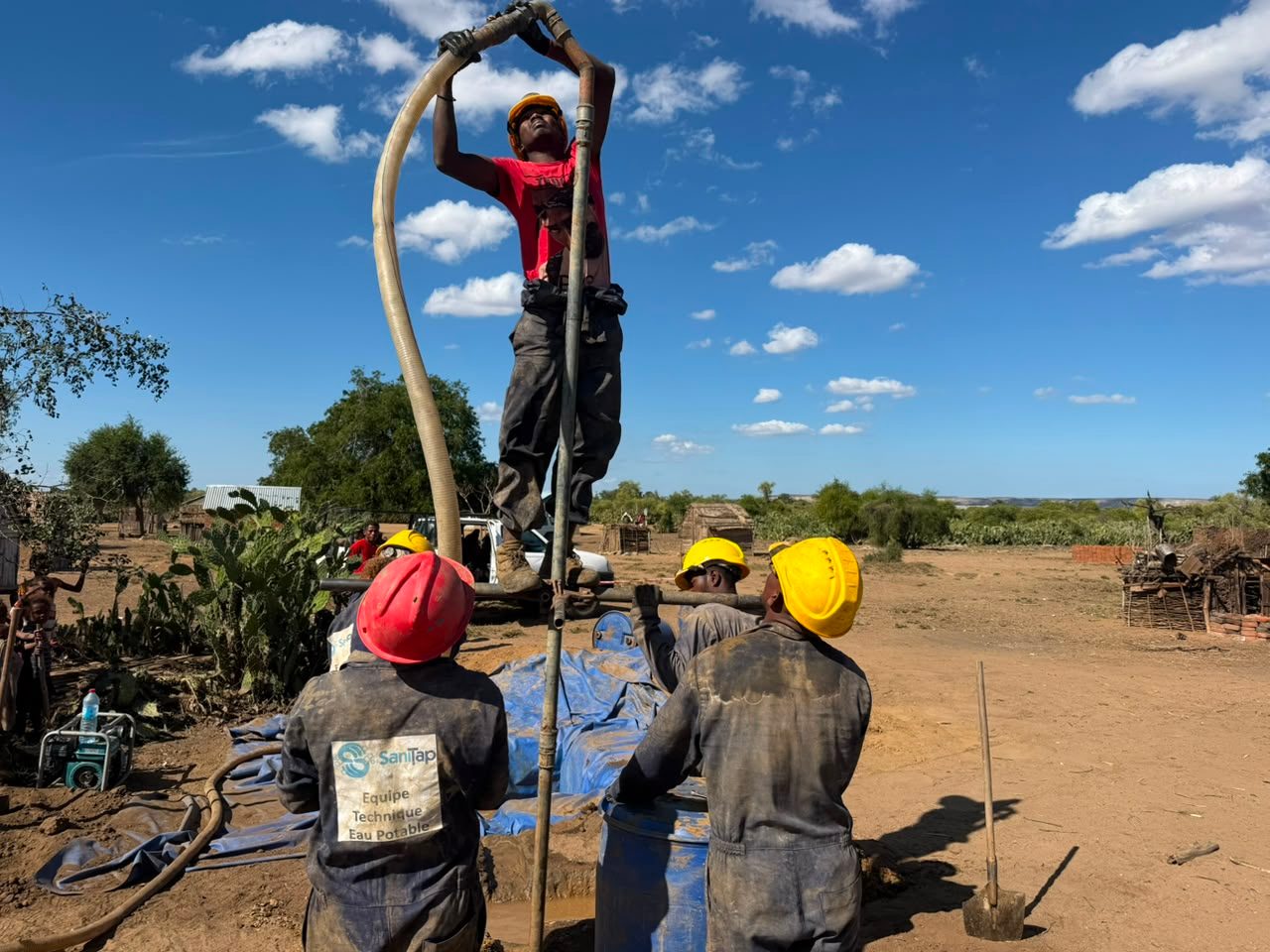
Every cyclone-response programme in a country like Madagascar faces the same fork in the road. A storm passes; wells are contaminated; boreholes are damaged; pumps are stripped from their mountings; piped systems are severed. The response programme has finite money and has to decide what to do with it.
The first option is to rehabilitate. Restore what was there before. Get the water flowing again as quickly and cheaply as possible. Move on to the next community. This is what the humanitarian response sector calls “return to baseline”. It is inexpensive per site, fast to deploy, and it visibly meets an immediate need.
The second option is to harden. Rebuild differently. Sealed boreholes, elevated storage, solar-powered pumps with battery backup, distribution networks engineered for Category 4-5 winds. This costs more per site, takes longer, and it addresses a need that has not fully arrived yet — the next storm.
Programmes that only do the first end up rebuilding the same infrastructure every three to five years, chasing the storms. Programmes that only do the second run out of political and community credibility because they leave immediate need visibly unmet while investing in the future. The right answer is not either-or. It is a sequenced combination, funded from the right instruments in the right order.
This article sets out where the finance boundary sits, when each path is appropriate, and how SaniTap’s three-phase Cyclone-Resistant Safe Drinking Water (CRSDW) programme is structured as a deliberate combined answer.
Executive summary
- Rehabilitation is the correct answer where the infrastructure was fit-for-purpose before the storm and the exposure is low enough that a rebuilt-same version will last.
- Hardening is the correct answer where the exposure is high enough that a rebuilt-same version will fail on a first-storm cycle. On Madagascar’s east coast, that is nearly everywhere with 3+ severe cyclones in 46 years.
- The finance boundary sits at the crediting instrument. Humanitarian response funds rehabilitation. Loss-and-damage finance (FRLD) and adaptation finance (ABM) fund hardening. Trying to fund hardening from humanitarian budgets loses; trying to fund rehabilitation from adaptation budgets fails additionality tests.
- SaniTap’s Phase 1 (81 systems, 214,657 people) is hardened rebuild in districts damaged by the 2026 cyclones — the loss-and-damage sequencing that combines both paths in one intervention.
- Phases 2 and 3 are pre-storm hardening on the forward-exposure ranking. This is pure adaptation.
- The combined answer is a three-phase sequence funded through complementary instruments (FRLD for Phase 1, Certified Adaptation Benefits for Phases 2 and 3), not a portfolio split.
Contents
Two paths, in shape
The rehabilitation path
Rehabilitation restores what was there. In water-infrastructure terms, that typically means:
- Repairing broken pumps.
- Sealing damaged well-heads to keep floodwater out.
- Replacing lost distribution pipework with equivalent gauge and material.
- Disinfecting sources contaminated by storm-driven flooding.
- Restoring the same power supply arrangement (usually diesel, sometimes grid, occasionally solar).
Cost per site is low. Deployment is fast. The community sees water flowing again within weeks. The response is visible, measurable, and satisfies humanitarian-response programme metrics (“N people restored to safe water within X days of the event”).
The critical property of rehabilitation is that the resulting infrastructure has the same vulnerability profile as what was destroyed. It failed once at this exposure. It will fail again at similar exposure.
The hardening path
Hardening rebuilds differently. In water-infrastructure terms, hardening typically involves:
- Sealed boreholes drilled deep enough that floodwater cannot penetrate the aquifer.
- Solar-powered pumps with battery backup, keeping the system running through prolonged cloud cover after a storm. A back-up diesel generator sits behind, used for no more than a small fraction of operating hours.
- On-site chlorination removing the need for downstream water-quality remediation.
- Elevated storage tanks positioned above maximum flood levels for the site.
- Distribution networks engineered for Category 4-5 wind and the follow-up flood.
Cost per site is higher — typically 2x to 4x a rehabilitation, depending on site-specific engineering. Deployment takes months rather than weeks. The community sees water flowing later than under rehabilitation, but the infrastructure that does come is designed to survive the next storm rather than fail in it.
The critical property of hardening is that the resulting infrastructure has a fundamentally different vulnerability profile. It is engineered against a storm scenario, not against a normal-conditions baseline.
Where the finance boundary sits
The two paths use different money because they satisfy different funding instruments’ criteria. Getting the finance boundary right is not a bureaucratic detail; it is the difference between an application that clears and one that fails.
Humanitarian response funds rehabilitation
Immediate-response humanitarian finance — UN Central Emergency Response Fund, IFRC Disaster Response Emergency Fund, ECHO humanitarian implementation plans, bilateral emergency contributions — funds response to an occurred event within a defined post-event window. Its metric is speed and reach: how many people restored to safe water, how many kilometres of temporary distribution, how many days after the event.
Rehabilitation fits humanitarian response cleanly. Hardening does not: humanitarian response typically has a 90-day or 180-day operational window; hardening takes longer than that; humanitarian response is not funded on a survives-the-next-storm criterion.
Attempting to fund hardening from a humanitarian budget usually fails the speed test and the metric test. The infrastructure the humanitarian budget produces will be rehabilitation, not hardening, because the incentive is to deploy visibly and quickly.
Loss-and-damage finance funds hardened rebuild
Loss-and-damage finance — the Fund for Responding to Loss and Damage (FRLD) established at COP27 and launched at COP28 — funds response to climate loss and damage. Its criteria include attribution (the harm is caused by climate change) and evidence (documented at site level). Its evaluation window is longer than humanitarian response, and its emphasis is on avoiding the same harm recurring.
Rebuilding damaged infrastructure to a hardened standard sits at the centre of FRLD’s mandate. FRLD does not preferentially fund pure rehabilitation (that is what humanitarian response is for), and it does not preferentially fund pure pre-event adaptation (that is what other adaptation instruments do). It funds the specific case of “the storm destroyed this infrastructure and rebuilding it the same way would leave the community exposed to identical destruction on the next storm-strike cycle”.[1]
Adaptation finance funds pre-event hardening
Adaptation finance — Green Climate Fund adaptation window, Adaptation Fund, bilateral adaptation programming, and the Adaptation Benefits Mechanism (ABM) that generates Certified Adaptation Benefits under Article 6.8 — funds reducing future vulnerability. Its criteria include additionality (would this have happened anyway?), a defined baseline against which the intervention is measured, and independent verification.
Hardening infrastructure ahead of storms it is expected to face is core adaptation. It fits ABM cleanly through SaniTap’s approved methodology Access to Tropical Storm-Resistant Safe Drinking Water Systems (v2.0, November 2024).
The compound instrument problem
Trying to fund hardening from a single instrument fails on both ends: humanitarian response won’t fund the extra spec; adaptation programming won’t fund a rehabilitation baseline. Trying to fund a combined intervention from one instrument alone forces false choices. The sequenced answer uses the right instrument for each phase, at the right time.
When rehabilitation is the right answer
Rehabilitation is the correct choice in three cases.
When the exposure is low enough that a rebuilt-same version will last. A community that has seen one damaging cyclone in 40 years, and that has a low forward-exposure projection, does not need the hardened spec. Rebuilding to the previous standard is proportionate and cost-effective.
When the infrastructure was fit-for-purpose before the storm. If the storm destroyed a well-designed system that would have kept working for another 20 years under normal conditions, rebuilding to that design is a rational restoration. The engineering was not the failure point.
When the constraint is time, not design. The immediate post-event window is not the moment to design a bespoke hardened rebuild. Restore access first with rehabilitation, then evaluate whether the site warrants hardening on the next investment cycle.
The trap to avoid: assuming rehabilitation is always the right answer because it is cheaper and faster. On coasts with three or more severe cyclones in 46 years — SaniTap’s cut-off for CRSDW eligibility — rehabilitation-only is a straight-line commitment to rebuild the same infrastructure every three-to-eight years, chasing every storm. The cumulative cost is much higher than a single hardened rebuild.
When hardening is the right answer
Hardening is the correct choice when the exposure profile makes rehabilitation-only a losing bet over the accounting period.
The specific test SaniTap applies is the CRSDW eligibility rule from the cyclone-exposure scoring methodology: the community must lie within 50 km of the coast and must have been hit by at least three severe cyclones (≥64 knots) since 1980. That is a return period under about 15 years, and it is a return period that a rehabilitated same-spec system will not outlast.
On Madagascar’s east coast and the north-west coast where cyclones Fytia and Gezani made landfall in 2026, the CRSDW eligibility criteria are met at 3,383 coastal fokontany. Nearly every one of them is a hardening case rather than a rehabilitation-only case.
The second and less obvious hardening trigger is methodology maturity. Where the hardened engineering pattern is well-understood (sealed borehole + solar pump + battery + chlorination + elevated storage + hardened distribution), deploying it is a matter of civil-engineering execution, not research. Its incremental cost over rehabilitation is well-characterised. Its verification pathway (through the ABM methodology) is defined. There is no experimental risk premium to add to the case.
SaniTap’s three-phase CRSDW as the combined answer
SaniTap’s CRSDW programme is structured to combine both paths on one timeline rather than force them to compete for the same finance.
Phase 1 — hardened rebuild, funded by loss-and-damage finance
Phase 1 is 81 systems serving 214,657 people, one system per fokontany, concentrated in the districts damaged by the 2026 cyclones (Fytia and Gezani) within the Government of Madagascar’s five priority regions (Atsinanana, Analanjirofo, Boeny, Analamanga, Melaky).[2]
Every Phase 1 site meets two conditions: it lies in a district with documented cyclone damage in the 2022-23 to 2025-26 seasons, and it lies inside the priority regions the Government has directed for the programme.[3]
Phase 1 is the hardened rebuild answer to the loss-and-damage question. The infrastructure that was destroyed is not being restored to its previous vulnerable state; it is being rebuilt to a specification designed to survive the next storm. Loss-and-damage finance (FRLD) fits the case precisely.
Phase 2 — forward-looking hardening, funded by adaptation finance
Phase 2 is the next roughly-80 systems on the forward-exposure ranking, taken in strict rank order without regard to whether the community was hit in the last three years. This is pre-event hardening, and it is core adaptation.
The finance route is not FRLD (that funds Phase 1’s loss-and-damage claim). It is Certified Adaptation Benefits (CABs) generated by Phase 1’s delivery under the ABM methodology, sold to buyers of certified adaptation, with the proceeds funding Phase 2. Together the two instruments form a financing cascade that turns one FRLD grant into a self-sustaining follow-on programme.
Phase 3 and beyond — extend the same logic
Phase 3 is funded by Phase 2’s CABs; the sequence continues. The full programme’s target is 480 systems reaching approximately 1.5 million people across six phases.
Why sequencing matters more than the mix
The temptation, faced with a combined rehabilitation + hardening need, is to split the budget: put N million into rehabilitation across many sites and (N/2) million into hardening at a handful of highest-priority ones. This is what a portfolio splitter does. It also produces the worst outcome, because it leaves most of the rehabilitated infrastructure at unchanged vulnerability and it fails to reach adaptation scale.
The sequenced answer is different: rebuild the most-damaged, highest-exposure communities to the hardened spec first, using loss-and-damage finance, and then extend the same hardened spec along the exposed coast on the forward-exposure ranking, using adaptation finance. Every site the programme touches ends up with hardened infrastructure. The rehabilitation-only case is only appropriate in low-exposure areas outside the CRSDW eligibility criteria, which are handled by other programmes.
Portfolio logic — why the sequence matters more than the mix
A funder evaluating cyclone-response applications is looking at essentially two questions.
First: is the intervention appropriately matched to the exposure? A rehabilitation-only application for a community with 3+ severe cyclones in 46 years is under-designed for the exposure. A hardened-rebuild application for a community with one severe cyclone since 1980 is over-designed. Both fail on match. The rank-and-filter approach in SaniTap’s CRSDW methodology is precisely a match test: 3,383 coastal fokontany filtered against the same exposure rule, no favouritism.
Second: does the application draw the right money for the right phase? A hardened-rebuild application submitted to humanitarian budgets will lose to faster rehabilitation applications. A pre-event hardening application submitted to loss-and-damage finance will lose to applications with a defensible attribution to occurred harm. A sequenced application that draws FRLD for Phase 1 (loss-and-damage) and ABM CABs for Phases 2-3 (adaptation) matches the instrument to the phase.
Where SaniTap’s three-phase design differs from the typical portfolio splitter is that every site the programme reaches gets the hardened spec, and every site the programme funds draws from an instrument whose criteria the intervention actually satisfies. There is no site that is under-designed for its exposure, and no site that is funded from an instrument whose test it does not pass.
The strategic bet underlying the design is that a coherent sequenced programme — one that combines loss-and-damage response with forward-looking adaptation, funded through complementary instruments — will out-perform a broken portfolio of unsequenced rehabilitations and one-off hardenings over the accounting period. On Madagascar’s east and north-west coasts, with cyclone intensity trending up under IPCC AR6 projections,[4] that bet is well-supported by the science.
Related articles
- Cyclone-exposure scoring — how SaniTap ranks 3,383 coastal fokontany — the site-selection methodology that separates hardening cases from rehabilitation-only cases.
- Article 6.8 and adaptation — non-market finance — the finance instrument (Certified Adaptation Benefits) for Phases 2 and 3, and background on the FRLD as post-event finance for Phase 1.
- Madagascar’s cyclones — the record, the outlook to 2100 — the exposure evidence that makes the hardening bet defensible.
Footnotes
FRLD’s operational criteria are being finalised by the Governing Board. The description in this article reflects the design principles set out in the COP27 and COP28 decisions and in the Board’s early operational guidance. Applicants should confirm current criteria with the Fund’s Secretariat. ↩︎
SaniTap, Note for Jan — Cyclone-resistant safe drinking water (CRSDW) for Madagascar: prioritisation approach and phasing, 16 July 2026. Source document in the SaniTap FNLD folder:
OneDrive - SaniTap/FNLD predictive modelling/Note for Jan - CRSDW prioritisation.docx. The 81-system Phase 1 sizing is the current programme design. ↩︎The site-selection methodology is set out in detail in the SaniTap Knowledge Hub article Cyclone-exposure scoring — how SaniTap ranks 3,383 coastal fokontany and in the source document
OneDrive - SaniTap/FNLD predictive modelling/CRSDW model - methodology explainer.docx. ↩︎IPCC Sixth Assessment Report, Working Group I contribution (AR6 WG1), Climate Change 2021: The Physical Science Basis. The report’s projections on tropical cyclone intensity, in particular the increase in the proportion of Category 3+ storms under warming scenarios, are the scientific basis for the forward-exposure component of SaniTap’s ranking. Available at www.ipcc.ch/report/ar6/wg1. ↩︎