

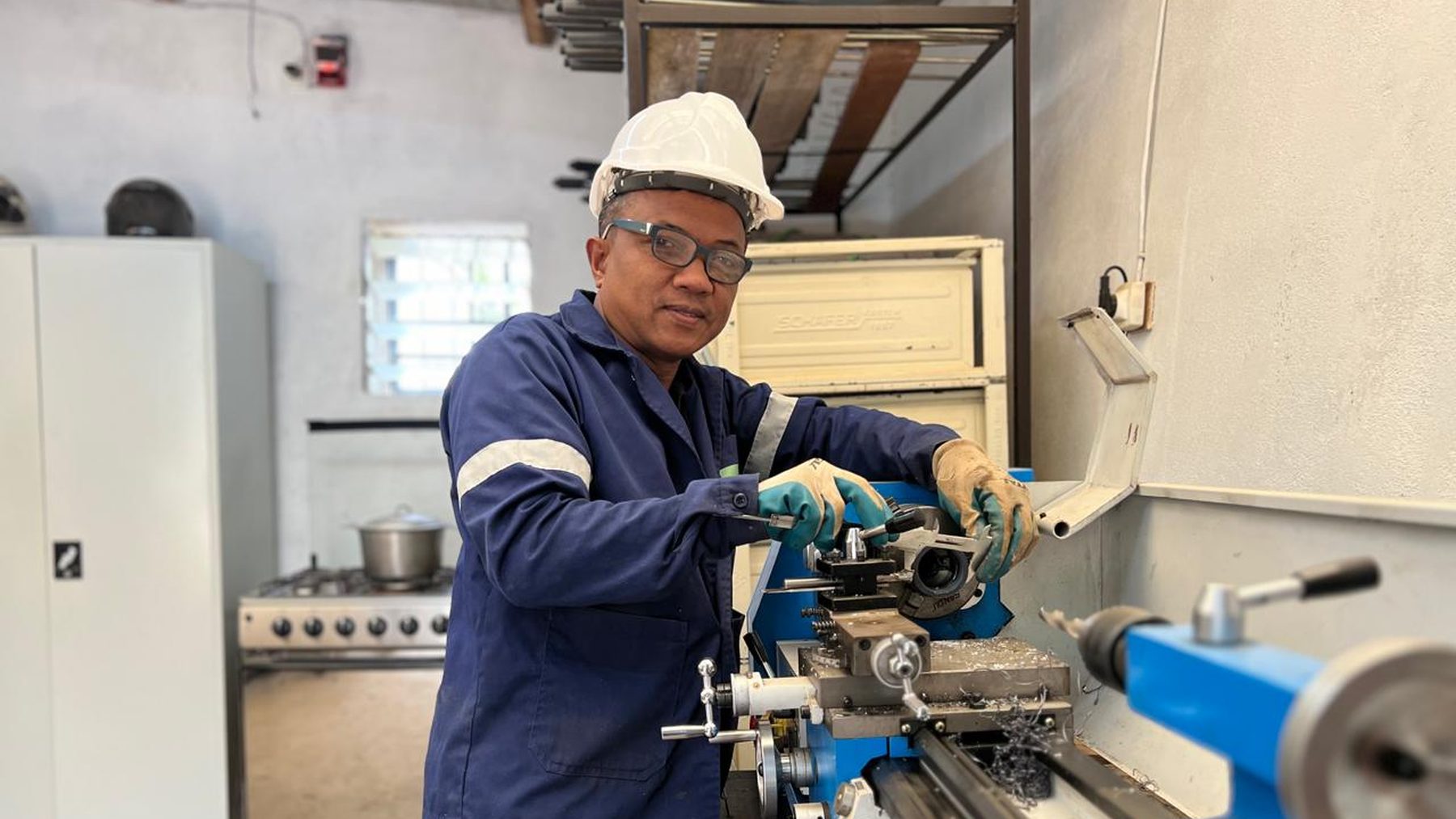
The gap between a good project idea and a delivered project outcome is not usually the idea. It is the operational discipline that stands between the two. Carbon and adaptation projects in rural Madagascar involve real people, real infrastructure, real risk of injury, and real accountability to funders and to certification bodies. Cutting corners on operations is how projects fail, how people get hurt, and how carbon credits get suspended.
SaniTap and MadAvance run to a set of operational standards that would look familiar to anyone who has worked in a well-run resource-sector operation. They exist because the alternative — informal, ad-hoc, “we know what we’re doing” delivery — produces exactly the failure modes that discredit the sector. This article sets out three intertwined disciplines: operational health and safety (the HSEC framework MadAvance operates to), MERV (Monitoring, Evaluation, Reporting and Verification — the impact accountability method), and the communications infrastructure (radio, mobile, social media, video, and the Vodafone partnership) that keeps all of it running at rural-community scale.
Executive summary
- HSEC discipline — SaniTap and MadAvance operate to Health, Safety, Environment and Community standards adopted from QMM / Rio Tinto’s Malagasy operation, one of the highest-bar heavy-industry standards in the country.
- The core tool is the Take 5 pre-task briefing — a two-minute stop before every field task where the team walks through the specific safety, environmental and quality risks of what they are about to do.
- MERV — Monitoring, Evaluation, Reporting and Verification — is the accountability framework behind every impact figure SaniTap publishes. It is required by Gold Standard, by the ABM, and by every credible carbon-market buyer; it is also how the programme itself learns and improves.
- The MERV plan is a living workbook, not a one-off document. Rates, samples, thresholds and audit trails are updated as the programme delivers.
- Communication infrastructure — mobile networks, radio, social media, video — is what makes MERV feasible in villages that are hours off tarmac. MadAvance’s partnership with Vodafone underpins the mobile-connectivity layer that lets field teams report, communities feed back, and headquarters see what is happening in real time.
- Together, these three disciplines are what turn a distributed stove or a rehabilitated pump into a certified, monitored, defensible outcome.
The HSEC framework, adopted from QMM
Rio Tinto’s QIT Madagascar Minerals (QMM) operation in the Anosy region is one of the largest heavy-industry operations in Madagascar. Its HSEC standards — Health, Safety, Environment, Community — are calibrated to global mining-industry norms and are one of the most demanding operational-discipline benchmarks in the country. MadAvance’s HSEC manual (Manuel HSEQ, version 1.1 QMM-aligned) is built on that inheritance.
That is a deliberate choice. Adapting a heavy-industry HSEC framework to a community-development delivery operation might sound like over-engineering. In practice it produces exactly the operational culture that community-development work needs and rarely gets: no assumption that a task is too small to plan, no assumption that a field team knows the risks without briefing, no assumption that community relations manage themselves.
The framework has four operational pillars.
Health. Personal-protective-equipment requirements for every field task. Vaccination and first-aid readiness for staff working in rural districts. Explicit protocols for handling hazardous materials in stove distribution or borehole rehabilitation.
Safety. Documented risk assessments for every recurring task type. Incident reporting that flows through the same structure as the QMM parent standard. A no-blame reporting culture that treats a near-miss as a learning event, not a disciplinary matter.
Environment. Every field intervention has an environmental-impact screen. Boreholes are sited to avoid groundwater cross-contamination; distribution vehicles have documented fuel-use monitoring; waste from stove installation is managed to the same standards a small industrial operation would apply.
Community. Stakeholder consultation, grievance channels open throughout the project lifetime, community engagement that continues after the initial intervention. This is the pillar that distinguishes a genuine community-development operation from a delivery operation with a community-relations bolt-on.
The Take 5
The most visible operational tool inside the HSEC framework is the Take 5 — a two-minute pre-task briefing that every field team runs before any recurring task type. The specific procedure:
- Stop. No task starts until the Take 5 is done.
- Look. What is the physical environment? What has changed since last time?
- Assess. What could go wrong — for people, for equipment, for the community?
- Control. What is the specific control for each risk? PPE, procedure change, second-person check?
- Proceed. Only when the team is aligned on the controls.
The Take 5 is a five-minute investment that catches the ninety-second lapse that produces incidents. It is a heavy-industry-inherited discipline that translates directly to community-development field work.
MERV — Monitoring, Evaluation, Reporting and Verification
Operational standards keep people safe. MERV keeps the impact honest. Every carbon-credit programme SaniTap runs is subject to a MERV framework required by the Gold Standard for Global Goals and, for the adaptation work, by the Adaptation Benefits Mechanism. Every ICVCM-CCP-aligned credit issuance depends on a MERV plan that a validator can audit.
MERV has four operational elements.
Monitoring. Continuous measurement of the parameters that produce the credit. For clean cooking under TPDDTEC v4.0 this includes stove distribution, adoption rates, Kitchen Performance Test results, sensor monitoring on a randomised subset of stoves, and stove-stacking evidence. For safe water under ERSDWS v1.0 it includes water-point functionality, water-quality tests, and household boil-water surveys.
Evaluation. Periodic independent assessment of the monitoring data against the methodology’s requirements. For the safe-water programme, the 2025 Cabinet MANO evaluation (commissioned by Medair) is the exemplar: an independent evaluator, published methodology, defensible sampling, and 97-100% functionality result across the sampled cohort.
Reporting. Structured reporting to the Gold Standard registry and to programme funders. This is what produces the Monitoring Reports (MR MP1, MP2, and so on) that are the auditable record of the programme’s delivered outcomes.
Verification. Third-party validation and verification by an accredited Validation and Verification Body (VVB). For SaniTap’s clean-cooking programme, Earthood and Ampere are the accredited VVBs; the MERV Report MP1 has been through their process and is the basis for the first-round credit issuance.
The MERV workbook
Behind the MERV framework sits a live workbook — the MERV Planning spreadsheet — that tracks every monitoring parameter, sample cadence, threshold, evidence artefact and audit interaction across the programme. It is not a one-off document produced for verification and shelved. It is the operational reference the programme actually uses, and it evolves as monitoring cycles complete and evidence accumulates.
The workbook links every claim on the site’s Impact Dashboard back through the MERV chain to the underlying evidence. Every figure has a source cited in the Impact Metrics workbook; every source is a MERV artefact; every MERV artefact is subject to the same verification standard as the carbon credit it underpins.
Communications infrastructure — what makes MERV feasible in rural Madagascar
MERV requires a data flow. Field measurements, incident reports, community feedback, verification requests, monitoring data — all of it has to travel from remote fokontany to the SaniTap operations centre and, in turn, to Gold Standard, to the VVB, to funders. In rural Madagascar, most of the districts SaniTap works in are hours off tarmac, patchy mobile coverage, no landlines, no reliable internet, and — until recently — no way to keep a field team connected in real time.
The communications layer that makes MERV operationally feasible is the point that quietly separates a programme that runs on evidence from a programme that runs on quarterly trip reports.
Mobile — MadAvance’s Vodafone partnership
MadAvance operates through Vodafone (Vodacom in East African branding) as its primary mobile operator, the network with the most extensive rural coverage in Madagascar. The partnership underpins several operational streams:
- Field-team connectivity. Repair technicians, distribution enumerators, MERV data-collection teams all carry mobile devices that report data back to the operations centre through the Vodafone network. mWater updates, KPT results, incident reports, community grievances — all flow through the same network.
- Community engagement. SMS and mobile-money channels reach households directly for hygiene promotion, service updates, and — for the Endur’O piped-water systems — NFC Smart Tap top-up notifications and dashboard reporting.
- M2M / IoT for stove sensors and Smart Taps. The randomised subset of cookstoves carrying usage sensors, and the Endur’O NFC Smart Tap network in the water programme, both rely on the same mobile-network layer to backhaul data.
Working with a single anchor mobile operator across the whole rural programme footprint means one contract, one billing relationship, one technical-support channel, and one coverage map that operations planning can rely on.
Radio
In areas beyond mobile coverage, MadAvance uses two-way radio as the fallback communication channel. Every field team carries a handset; every base station monitors the shared frequency. This is not glamour technology, but it is what keeps a repair team in contact with a district office when a cyclone has knocked out cell towers and the road is under water.
Community radio also plays a public-facing role. Local radio stations in the programme regions carry SaniTap and MadAvance content on hygiene promotion, water-system availability, cookstove adoption, and safety messaging. Radio remains the most widely-received medium in rural Malagasy communities; using it deliberately, in local languages, is a direct extension of the community-engagement pillar of the HSEC framework.
Social media and video
For funder and stakeholder reporting, and for wider public communication of the programme’s work, SaniTap and MadAvance produce photo, video and social-media content documenting the programmes in operation. This is not marketing polish for its own sake; it is a way of making the intervention visible and verifiable to audiences who cannot travel to the field. Photo mosaics of clean-cookstove distribution, short-form video of hand-pump rehabilitation, stakeholder interviews, and dashboards published on the sanitap.org site all sit inside this stream.
The whole thing
Put together: an HSEC framework calibrated to heavy-industry standards; a Take 5 pre-task discipline that catches the near-miss before it becomes an incident; a MERV method that runs continuously from monitoring through to verification; and a communications layer — Vodafone-anchored mobile, radio backup, deliberate use of social media and video — that keeps the whole operation connected across rural distances and reporting cycles.
None of it is glamorous. All of it is unavoidable. And the outcome — programmes that deliver as designed, evidence that stands up to third-party verification, credits that get issued and accepted by the highest-integrity buyers — is what the whole operational stack is for.
What this means for the impact numbers on this site
Every number on the live impact tracker, the Impact Dashboard, the home page stat strip and every article that cites a figure is traceable through this operational stack. A tCO₂e figure is a MERV output; a MERV output is a monitored parameter; a monitored parameter is a field measurement; a field measurement is a MadAvance data-collection team; a MadAvance data-collection team is an HSEC-briefed team using Vodafone mobile connectivity to report their result to the operations centre before the day’s field work ends. Every step has a name against it.
This is what “one source of truth” actually rests on. It is not a spreadsheet. It is the operational discipline the spreadsheet records.
Related
- Impact as outcome — theory of change and the discipline of behavioural monitoring — the wider impact-accountability approach the MERV framework sits inside.
- SaniTap–MadAvance model — company speed, NGO trust — the partnership that carries the operational-standards inheritance.
- Piped water at scale — how Endur’O turns a fragile utility into a durable one — where the NFC Smart Tap communications layer runs.
- TPDDTEC v4.0 — how clean cookstove credits are calculated — the methodology whose MERV requirements the whole framework serves.
Footnotes
Source documents referenced from the SaniTap Carbon and MadAvance folders:
Clean Cooking - Documents/General/HSEQ Health and Safety/MANUEL HSEQ MSv1.1.QMM.pdf— the MadAvance Health, Safety, Environment and Quality manual, adopted from QIT Madagascar Minerals (Rio Tinto).Clean Cooking - Documents/General/Reports/RTNS/LES OUTILS HSEQ MADAVANCE.pptx— the operational HSEQ toolset.MadAvance - Documents/General/HSEC/Take 5 A4 format 241204.docx— the Take 5 pre-task briefing card.Carbon - Documents/Carbon Programme/TPDDTEC/20250808 MERV_Planning.xlsx— the live MERV planning workbook.Carbon - Documents/Gold Standard SaniTap Submission/VPA-3 GS12851 Improved Cooking (real-case)/4. VVB Verification MP1/4. R3/GS12600_stove_alterations_MERV_Report_MP1.pdf— the first-round MERV Report for the clean-cooking programme.