

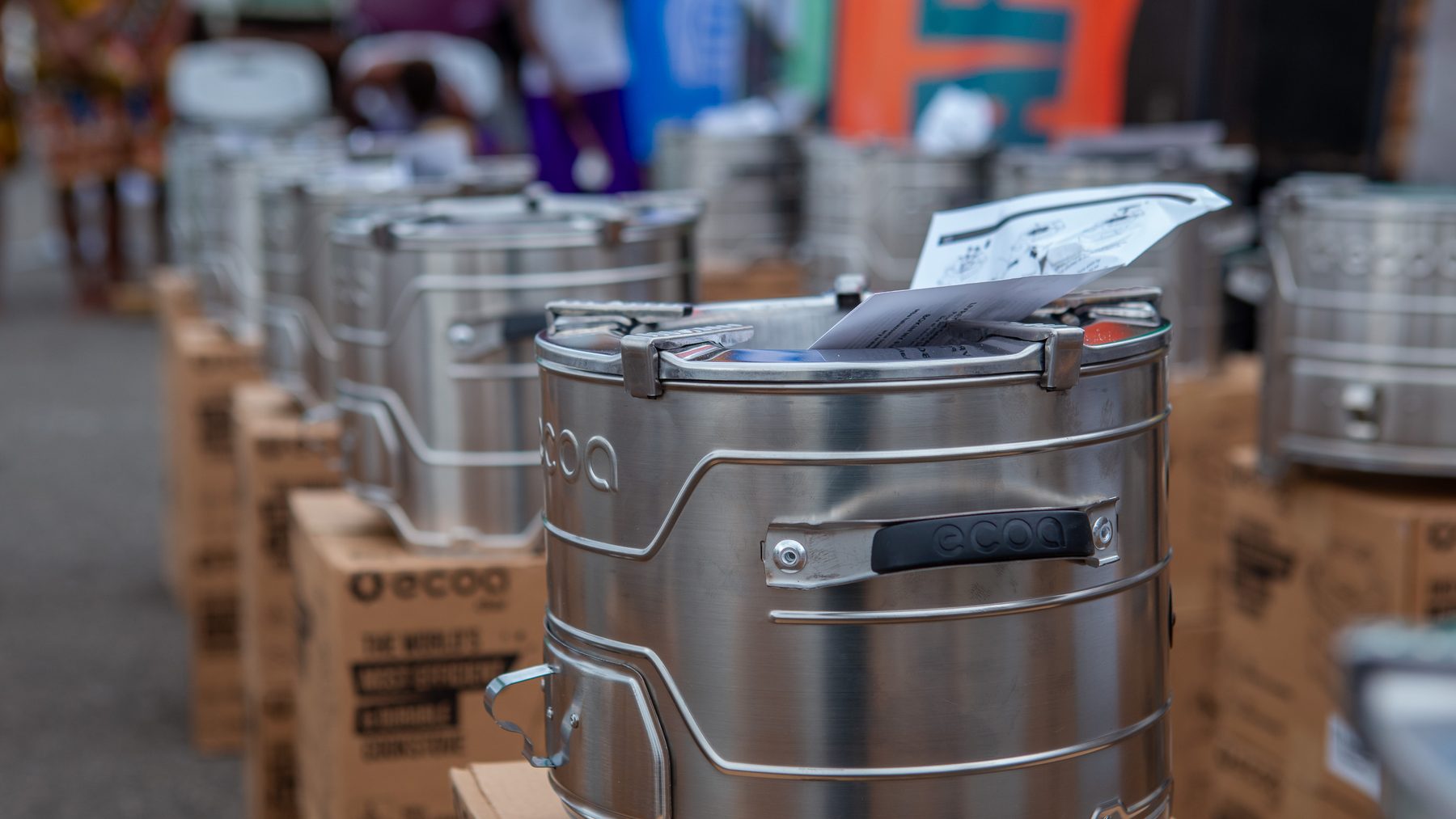
Household air pollution from cooking is the largest single environmental risk to human health in low-income countries. It kills more people every year than malaria, HIV/AIDS and tuberculosis combined. It disables far more than it kills. It falls disproportionately on women, who do the cooking, and on children, who breathe the smoke while they cling to their mothers. And because most of its victims are in rural households in low-income countries, most of it never appears in the health statistics of the industrialised world.
This article sets out the scale of the disease burden, the diseases specifically caused, the demographic and economic pattern, why improved cookstoves are the primary intervention, and the measurement protocol SaniTap is deploying in Madagascar with Berkeley Air Monitoring Group to quantify — and eventually certify — the health outcome of its clean cooking programme under the Gold Standard aDALY methodology.
Executive summary
- 3.2 million premature deaths a year worldwide from household air pollution (WHO 2020). Around 237,000 children under 5 die each year from pneumonia caused by HAP.
- 2.4 billion people globally cook with polluting fuels: wood, charcoal, agricultural residues, dung.
- The disease burden: pneumonia (especially children), chronic obstructive pulmonary disease (COPD), lung cancer, ischaemic heart disease, stroke, low birth weight, cataracts.
- DALYs lost: HAP is one of the top ten global risk factors by DALY loss. Millions of years of healthy life gone each year, disproportionately in low-income countries.
- Economic cost: WHO estimates HAP costs the world US$2.4 trillion per year in premature deaths, ill health and lost productivity — roughly the annual GDP of France.
- Gender and age: women (who cook) and children under 5 (who are held or nearby during cooking) bear almost all the exposure.
- Improved cookstoves cut PM₂.₅ exposure at the point of cooking, which cuts the disease burden. The scale of the reduction depends on the technology, adoption rate, and stove-stacking discipline.
- SaniTap measures it: 48-hour personal PM₂.₅ exposure sampling on primary cooks, converted to averted-DALY estimates using the HAPIT model, following the Gold Standard aDALY methodology, with Berkeley Air Monitoring Group as the technical partner.
The problem in numbers
The WHO’s most recent global estimate puts household air pollution deaths at 3.2 million per year (2020 data, published in the 2022 WHO fact sheet on household air pollution).[1] For context that is roughly:
- More than the annual death toll from HIV/AIDS, tuberculosis, and malaria combined.
- Roughly equivalent to the death toll of every road-traffic accident on the planet, every year.
- About one death every ten seconds.
Of the 3.2 million, around 237,000 are children under five, mostly from acute lower respiratory infections — chiefly pneumonia. Pneumonia is the biggest single killer of children under five worldwide; household air pollution is one of its major causes.
Roughly 2.4 billion people — nearly one in three human beings alive today — cook their food on open fires or with low-efficiency stoves fuelled by wood, charcoal, crop residues or dung. Sub-Saharan Africa is disproportionately represented: in Madagascar, more than 95% of rural households cook with biomass on traditional stoves.
The diseases it causes
Household air pollution is not a single disease. It is an exposure — very fine particulate matter (PM₂.₅), carbon monoxide, black carbon and volatile organic compounds — inhaled daily, at close range, over years. The WHO’s Global Burden of Disease attribution assigns the following disease outcomes to HAP:
- Acute lower respiratory infections (pneumonia), especially in children under five. This is the disease that produces the young-child mortality figures. Children exposed to HAP have roughly double the pneumonia risk of unexposed children.
- Chronic obstructive pulmonary disease (COPD), in adults with lifelong exposure. Women cooking on biomass fires face significantly elevated COPD risk in later life.
- Lung cancer, particularly from coal smoke but also from biomass with certain combustion patterns.
- Ischaemic heart disease and stroke. PM₂.₅ enters the bloodstream, promotes atherosclerosis, and raises cardiovascular event risk. HAP is a substantial contributor to cardiovascular disease burden in exposed populations.
- Low birth weight and adverse birth outcomes in women exposed during pregnancy.
- Cataracts, particularly from prolonged smoke exposure in the eye.
The WHO categorises HAP as a Group-1 carcinogen through the International Agency for Research on Cancer classification, and the Global Burden of Disease study includes HAP as one of the top ten global risk factors by DALYs lost each year.[2]
DALYs — the unit that captures the disability, not just the death
A disability-adjusted life year (DALY) is the standard health-economics unit for the combined weight of premature death and years lived with disability. One DALY equals one year of healthy life lost. It matters here because household air pollution’s toll is much larger than its mortality figure alone suggests: it is not only killing 3.2 million people a year; it is also disabling hundreds of millions with chronic respiratory illness, cardiovascular disease and cognitive-development impacts that reduce quality of life without appearing in a mortality count.
The Global Burden of Disease study attributes on the order of 91 million DALYs per year to household air pollution — a large fraction of the total global DALY burden from environmental risk factors. In low-income countries where HAP exposure is highest, it is one of the top three modifiable risk factors, competing only with malnutrition and unsafe water/sanitation.
Scaled to Madagascar
Madagascar sits in the East and Southern Africa GBD Super Region. In this region, 30% of all deaths in the first month of life are linked to air pollution, and the majority of that burden is household air pollution from cooking with solid fuels (State of Global Air 2024).[3]
More than 95% of rural Malagasy households cook with biomass on traditional stoves. Madagascar sits in the small cluster of African countries where household air pollution is the dominant paediatric-respiratory risk factor — the same profile as Niger, Uganda, Rwanda, Malawi, Ethiopia, Mozambique and Senegal, where State of Global Air 2024 reports that more than 40% of all deaths from lower respiratory infections in children under five are attributed to air pollution.
HAP is one of Madagascar’s top three environmental risk factors, alongside unsafe water/sanitation and undernutrition. Country-specific figures — DALYs, under-5 mortality rates, population-weighted PM₂.₅ — are available in the SoGA data explorer at stateofglobalair.org/data.
The DALY framing is what makes intervention accountability quantifiable. When SaniTap distributes improved cookstoves, reduces PM₂.₅ exposure among primary cooks, and lowers the incidence of the diseases listed above, the reduction can be quantified in DALYs averted. This is the “aDALY” — the averted-DALY unit — that the Gold Standard has developed a formal methodology to measure and certify.[4]
The economic cost — GDP, lost earnings and lost potential
The economic cost of HAP is more than the direct health-system cost of treating its diseases. It has three additional layers:
Lost productivity. Women who cook and children who are sick lose working and school hours. In an economy where women’s cash and subsistence economic activity is central to household survival, the productivity loss from HAP-attributable illness is substantial.
Fuel-collection burden. Households cooking on inefficient stoves consume more biomass per meal. The time women and girls spend collecting firewood — often hours a day in areas where forests have receded — is time not available for paid work, subsistence farming, childcare or education.
Lost potential. A child who survives HAP-caused pneumonia can still have permanently reduced lung capacity that shapes her adult health and earning ability. A daughter kept out of school to gather firewood or care for a sick sibling loses lifetime earning potential. These effects compound across a generation.
The WHO’s aggregate estimate puts the global cost of HAP at US$2.4 trillion per year in premature deaths, ill health and productivity loss. For context that is roughly the annual GDP of France. It falls almost entirely on countries that had almost nothing to do with the industrial emissions responsible for global climate change, and yet find themselves burdened both by exposure and by the fuel-poverty conditions that produce it.
Scaled to Madagascar
Madagascar’s nominal GDP is around US$16 billion (World Bank, 2024). WHO’s cross-country analysis places household-air-pollution-attributable economic cost in high-exposure low-income countries at 4-8% of GDP.
- Around US$0.6 to US$1.3 billion per year in HAP-attributable cost to Madagascar’s economy — premature deaths, treated illness, lost women’s and children’s productivity, fuel-collection time not spent on paid work or schooling.
- Roughly 4-8% of national GDP flowing out of the economy through preventable exposure to cooking smoke.
- In a country where median rural household income is measured in hundreds of dollars per year, the per-household share is material to daily household finances.
Sources: WHO health-economics estimates on HAP burden in low-income countries; World Bank Madagascar GDP data.
Who is exposed — gender and age
Household air pollution is one of the few global health risks that is more or less physically gendered by the mechanism of exposure. In the overwhelming majority of low-income households, women do the cooking. Older daughters share the work from about age eight. Men are typically not at the stove, though they may be exposed in the same room.
The consequence is that women’s personal PM₂.₅ exposure in a household cooking on biomass is far higher than men’s, often by an order of magnitude. Children under five, held or seated near the cook, receive the second-highest exposure dose. Infants strapped to the mother’s back while she cooks may inhale concentrated smoke at close range for hours each day.
This is why HAP is described as a women-and-children problem. It is not that men are unaffected. It is that the daily-hours-times-concentration exposure metric is dominated by women and by their under-five children. The WHO’s disaggregated statistics reflect this: the 237,000 under-five HAP deaths, and a disproportionate share of the adult COPD, cardiovascular and lung-cancer death burden in exposed populations, fall on women.
The design implication for a clean cooking programme is that the health outcome is not evenly distributed across household members. It is concentrated on the person at the stove, and it flows through their reduced pneumonia risk, their reduced COPD progression, their reduced cardiovascular event risk over the years of subsequent life.
Why improved cookstoves are the primary intervention
The pathway from HAP to disease runs through PM₂.₅ exposure at the point of cooking. Anything that reduces that exposure reduces the disease burden. There are three broad intervention categories:
- Fuel switching — moving households from biomass to clean fuels (LPG, electricity, ethanol). Cleanest per-cook but requires infrastructure and household economics that most rural low-income settings do not yet have.
- Improved cookstoves — high-efficiency biomass stoves that burn cleaner, faster and hotter. Middle-ground: substantially reduce PM₂.₅ emissions without requiring a fuel switch, and deployable at scale in rural biomass economies.
- Ventilation and behavioural change — chimneys, ventilated kitchens, cooking outdoors. Cheapest but produces the smallest reduction in personal exposure.
In Madagascar, where 95%+ of rural households cook with biomass and where LPG or electricity access is decades from being universal, improved cookstoves are the pragmatic large-scale intervention. This is why SaniTap’s clean cooking programme is built around biomass stove distribution — currently two technologies, improved-efficiency natural draft stoves and pellet gasifier stoves — under the Gold Standard TPDDTEC v4.0 methodology.[5]
A modern improved cookstove can reduce fuel consumption 40-50% per meal against an open fire. Its PM₂.₅ emission reduction depends on the specific technology; a pellet gasifier stove burning densified biomass produces close to LPG-level indoor air quality, while an improved natural draft stove reduces exposure substantially but still emits meaningfully more than a clean fuel. Both, deployed at scale and adopted as the primary cooking device, produce measurable reductions in the disease burden the exposure causes.
The critical qualifier is adopted as the primary cooking device. A stove that sits on the shelf while the family continues to cook on the traditional fire produces no health benefit. A stove that is used only for particular meals while the traditional fire remains lit — the phenomenon known as stove stacking — produces a smaller benefit than the theoretical single-stove-use scenario. The behavioural side of the intervention is a much larger fraction of the total health outcome than the pure engineering.
How the health outcome is measured
Measuring the health outcome of an improved cookstove programme is not a matter of counting stoves. It requires measuring the change in PM₂.₅ exposure among the actual primary cooks and converting that measured exposure change into modelled health outcomes using an accepted framework.
The Gold Standard has developed a specific methodology for this: the aDALY methodology (Methodology to Estimate and Verify Averted Disability-Adjusted Life Years from Cleaner Household Air).[4:1] It sets out the sampling design, the measurement protocol, the modelling framework, and the verification requirements.
The measurement chain has four steps.
Step 1: personal exposure sampling. A representative sample of primary cooks in intervention households (using the improved stove) and control households (still using traditional cooking) each wear a personal PM₂.₅ exposure monitor for 48 hours. The monitor sits at the cook’s breathing zone and records the actual particulate concentration in the air the cook is inhaling, not a room-average or a stove-emission proxy.
Step 2: statistical design meets the 90/30 precision rule. Sample sizes are set so the two-sided 90% confidence interval around the mean exposure lies within ±30% of the mean, for each study arm. In practice this requires roughly 30-60 households per arm depending on the sampling design (simple random or cluster-randomised), with oversampling to account for missing or invalid samples.
Step 3: exposure delta to health outcome via HAPIT. The measured PM₂.₅ exposure reduction is converted to health-outcome estimates using the Household Air Pollution Intervention Tool (HAPIT), a peer-reviewed model developed by researchers including the Berkeley Air group. HAPIT applies published exposure-response functions for each HAP-attributable disease (pneumonia, COPD, lung cancer, ischaemic heart disease, stroke, low birth weight) to project the DALYs averted per household over the intervention lifetime.
Step 4: verification. Under the Gold Standard-certified aDALY route, an accredited verifier reviews the sampling protocol, the exposure data, the HAPIT modelling and the assumptions, and either issues certified aDALY units or requires revision. Certified aDALYs can be reported alongside carbon credits as health co-benefits with third-party assurance.
What SaniTap is doing — with Climate-Solutions Consulting
SaniTap has partnered with Climate-Solutions Consulting to install indoor-air-pollution sensors in sample households across the clean cooking programme in Madagascar, and to run continuous digital PM₂.₅ monitoring around and beyond the Kitchen Performance Test (KPT) windows.
The distinctive feature of the approach is that it does not stop at the KPT event itself. Traditional KPT-based measurement takes a snapshot of exposure during the test period and treats the result as representative. Sensor-based continuous monitoring goes further: the same instruments stay in the household after the KPT is complete and continue to record PM₂.₅ concentration at high sampling frequency, across weeks and months, capturing the day-to-day reality of the household’s exposure profile — including morning cooking peaks, evening peaks, seasonal shifts, weather variation and the presence or absence of stove stacking.
That continuous digital record produces three things a periodic-survey approach cannot:
Greater accuracy. Personal PM₂.₅ exposure varies substantially day-to-day. A single 48-hour KPT sample can be atypical for the household — a windy day, a family visit, an unusual cooking pattern. A continuous multi-week sensor record produces a stable exposure estimate that is much closer to the household’s true long-run mean.
Greater integrity. Sensor data is timestamped, remotely transmitted, and cannot be quietly re-worked after the fact. The audit trail is objective and available for third-party verification with no reliance on self-report or intermittent field visits.
Behavioural evidence beyond adoption. Continuous monitoring detects stove stacking — the failure mode where the improved stove is used alongside the traditional fire — by picking up the PM₂.₅ signature of biomass burning that the pellet gasifier stove alone would not produce. It is direct evidence of what the household is doing, not what the household says it does.
This continuous digital monitoring approach is recognised by the Gold Standard as a valid mechanism for supporting the aDALY methodology’s exposure-measurement requirement, and it is expected to strengthen the case for higher-integrity, third-party-verifiable health outcomes than the point-in-time-only alternative.
The programme’s clean-cooking KPT cycles run through the Monitoring Report periods (MP1 already complete, subsequent MPs in the crediting cycle). The sensor data flows continuously alongside those cycles, giving both the periodic-benchmark discipline the methodology requires and the ongoing-behavioural-evidence discipline that catches drift before it becomes reversion.
How the aDALY figure connects to the impact numbers on this site
The workbook figure that appears in the site’s live impact tracker and Impact Dashboard for DALYs averted (currently around 5,400 per year rate) is drawn from the Gold Standard feasibility-study projection for SaniTap’s clean cooking programme — 99,600 aDALYs over the 15-year crediting period, which apportions to about 6,640 aDALYs per year at design case.
Once the Berkeley Air measurement campaign completes and the HAPIT modelling is done on the actual exposure data, the workbook figure will be updated to reflect the measured outcome rather than the design-case estimate. That is the pattern SaniTap’s impact-measurement approach commits to: replace projections with monitored actuals as the evidence base matures.
Until then, the site’s aDALY figure is honestly labelled as a design-case projection. When the measurement result lands, the workbook cell changes, the site updates on the next deploy, and every place that quotes the number — this article included — shifts in lockstep.
What the impact looks like in a household
Statistics do not describe what the improved stove actually changes at the point of cooking. Concretely, what a switch from a three-stone fire to a working pellet gasifier stove means for a Malagasy family:
- The cook’s PM₂.₅ exposure at the breathing zone drops by roughly an order of magnitude, from very-hazardous WHO-guideline-exceeding levels into a range approaching clean-fuel norms.
- The pneumonia risk for children under five in the household falls substantially. In a sample of enough households, the reduction is measurable in fewer clinic visits, fewer hospitalisations, and fewer under-five deaths.
- The cook’s own long-run risk of COPD, ischaemic heart disease and lung cancer falls. She does not see this benefit as a single event; she experiences it as more years of healthy life, aggregated over decades.
- Time spent collecting firewood shrinks because the improved stove burns much less fuel per meal. Time reclaimed by women averages 2.55 hours per household per day, verified in the Gold Standard MR MP1 monitoring.
- The kitchen is habitable. Smoke that used to fill the cooking space and stream past children’s faces is no longer there.
These are the human outcomes the DALY figures aggregate. The article’s opening statistic — 3.2 million premature deaths a year, 237,000 of them children — becomes actionable when it is disaggregated to the household level and the household is fitted with a stove that measurably cuts the exposure that causes those deaths.
Related
- Impact as outcome — theory of change and the discipline of behavioural monitoring — the wider framework the aDALY monitoring sits inside.
- TPDDTEC v4.0 — how clean cookstove credits are calculated — the carbon-side methodology that funds the intervention whose health outcome this article measures.
- Gender-responsive, not gender-sensitive — why the women-and-children exposure pattern makes gender-responsive design mandatory.
- Two levers, one country — how clean cooking and safe water avoid emissions in Madagascar — the two-strand mitigation portfolio that produces the same PM₂.₅ reduction from both cooking and safe-water sides.
Footnotes
World Health Organization, Household air pollution fact sheet, updated 2024. Available at who.int/news-room/fact-sheets/detail/household-air-pollution-and-health. Key figures cited: 3.2 million premature deaths per year; 2.4 billion people cooking with polluting fuels; approximately 237,000 children under five deaths per year attributable to household air pollution. ↩︎
Institute for Health Metrics and Evaluation, Global Burden of Disease Study. HAP consistently ranks in the top ten global risk factors by DALYs lost. Reference: www.healthdata.org/research-analysis/gbd. ↩︎
Health Effects Institute, State of Global Air 2024. Special Report, Boston, MA: Health Effects Institute. Key figures cited: 8.1 million air-pollution-attributable deaths globally in 2021 (38% from household air pollution); 572,000 neonatal deaths linked to air pollution (72% from household air pollution); 47% of world population (approximately 3.6 billion people) still cooking with solid fuels; in 18 African countries — including named neighbours Burundi and Uganda — more than 95% of the population relies on solid fuels for cooking; in East, West, Central and Southern Africa, 30% of all deaths in the first month of life are linked to air pollution; in Niger, Rwanda, Malawi, Senegal, Ethiopia, Uganda and Mozambique, more than 40% of under-5 lower-respiratory-infection deaths are attributed to air pollution. Full report and country-level data explorer at www.stateofglobalair.org. ↩︎
Gold Standard, Methodology to Estimate and Verify Averted Disability-Adjusted Life Years (ADALYs) from Cleaner Household Air, v1.0, HI-ICS. Source document held in the SaniTap Carbon folder:
Carbon - Documents/Carbon Programme/aDALY methodology - GS/. See https://www.goldstandard.org/. ↩︎ ↩︎The TPDDTEC v4.0 methodology and its application to SaniTap’s clean cooking programme is set out in detail in the SaniTap Knowledge Hub article TPDDTEC v4.0 — how clean cookstove credits are calculated. ↩︎